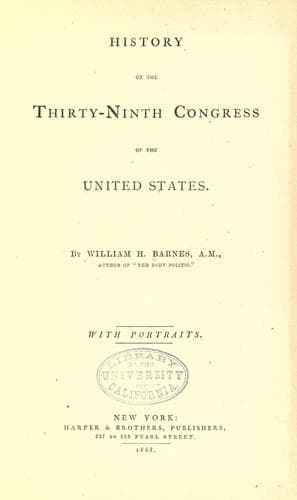
History of the Thirty-Ninth Congress of the United StatesBarnes, William Horatio
History
History of the Thirty-Ninth Congress of the United States
Barnes, William Horatio
United States -- Politics and government -- 1865-1869; United States. Congress (39th : 1865-1867)
In this direction he was desirous of avoiding a veto. He said:
"Moreover, on grounds of expediency, upon which I will not dwell, I
desire myself, and I should feel much relieved if I thought the House
fully and heartily shared my anxiety, not to pass here any bill which
shall be intercepted on its way to the statute-book by well-grounded
complaints of unconstitutionality on the part of any other department
of the Government."
Mr. Delano, of Ohio, followed, expressing doubts as to the
constitutionality of the measure. He considered it a serious
infringement of the rights of the States. He said: "Now, sir, should
this bill be passed, that law of the State might be overthrown by the
power of Congress. In my opinion, if we adopt the principle of this
bill, we declare, in effect, that Congress has authority to go into
the States and manage and legislate with regard to all the personal
rights of the citizen--rights of life, liberty, and property. You
render this Government no longer a Government of limited powers; you
concentrate and consolidate here an extent of authority which will
swallow up all or nearly all of the rights of the States with respect
to the property, the liberties, and the lives of its citizens."
He added, near the close of his address: "I am not to be understood as
denying the power of this Government, especially that great war power
which, when evoked, has no limit except as it is limited by necessity
and the laws of civilized warfare. But, sir, in time of peace I would
not and I can not stand here and attempt the exercise of powers by
this General Government, which, if carried out with all the logical
consequences that follow their assumption, will, in my opinion,
endanger the liberties of the country."
Mr. Kerr, of Indiana, maintained the theory that the States should
settle questions of citizenship as relating to those within their
borders; that "the privileges and immunities of citizenship in the
States are required to be attained, if at all, _according to the laws
or Constitutions of the States_, and never in _defiance_ of them." To
sustain this theory, he read from a number of authorities, and finally
remarked:
Public-domain text, read in full here on John Shaqi.
Reviews
Reviews
No reviews yet
Be the first to share your thoughts on this work.
Elsewhere in the archive
Join the Discussion
Join the discussion
Sign in to leave a comment or review.
Sign InorCreate an account