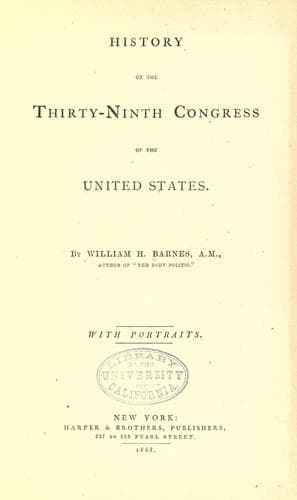
History of the Thirty-Ninth Congress of the United StatesBarnes, William Horatio
History
History of the Thirty-Ninth Congress of the United States
Barnes, William Horatio
United States -- Politics and government -- 1865-1869; United States. Congress (39th : 1865-1867)
Mr. Bingham said: "And, first, I beg gentlemen to consider that I do
not oppose any legislation which is authorized by the Constitution of
my country to enforce in its letter and its spirit the bill of rights
as embodied in that Constitution. I know that the enforcement of the
bill of rights is the want of the republic. I know if it had been
enforced in good faith in every State of the Union, the calamities,
and conflicts, and crimes, and sacrifices of the past five years would
have been impossible.
"But I feel that I am justified in saying, in view of the text of the
Constitution of my country, in view of all its past interpretations,
in view of the manifest and declared intent of the men who framed it,
the enforcement of the Bill of Rights, touching the life, liberty, and
property of every citizen of the republic, within every organized
State of the Union, is of the reserved powers of the States, to be
enforced by State tribunals and by State officials, acting under the
solemn obligations of an oath imposed upon them by the Constitution of
the United States. Who can doubt this conclusion who considers the
words of the Constitution, 'the powers not delegated to the United
States by the Constitution, nor prohibited by it to the States, are
reserved to the States respectively, or to the people?' The
Constitution does not delegate to the United States the power to
punish offenses against the life, liberty, or property of the citizen
in the States, nor does it prohibit that power to the States, but
leaves it as the reserved power of the States, to be by them
exercised. The prohibitions of power by the Constitution to the States
are express prohibitions, as that no State shall enter into any
treaty, etc., or emit bills of credit, or pass any bill of attainder,
etc. The Constitution does not prohibit States from the enactment of
laws for the general government of the people within their respective
limits.
"The law in every State should be just; it should be no respecter of
persons. It is otherwise now, and it has been otherwise for many years
in many of the States of the Union. I should remedy that, not by
arbitrary assumption of power, but by amending the Constitution of the
United States, expressly prohibiting the States from any such abuse of
power in the future. You propose to make it a penal offense for the
judges of the States to obey the Constitution and laws of their
States, and for their obedience thereto to punish them by fine and
imprisonment as felons. I deny your power to do this. You can not make
an official act, done under color of law, and without criminal intent,
and from a sense of public duty, a crime."
[Illustration: James F. Wilson.]
Public-domain text, read in full here on John Shaqi.
Reviews
Reviews
No reviews yet
Be the first to share your thoughts on this work.
Elsewhere in the archive
Join the Discussion
Join the discussion
Sign in to leave a comment or review.
Sign InorCreate an account