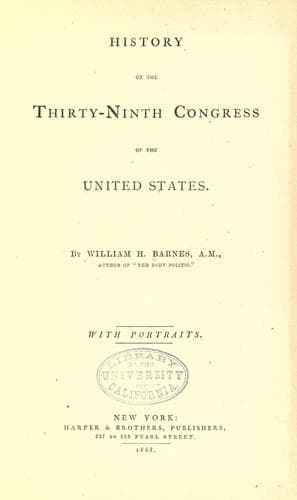
History of the Thirty-Ninth Congress of the United StatesBarnes, William Horatio
History
History of the Thirty-Ninth Congress of the United States
Barnes, William Horatio
United States -- Politics and government -- 1865-1869; United States. Congress (39th : 1865-1867)
Mr. Shellabarger of Ohio said: "I do not understand that there is now
any serious doubt anywhere as to our power to admit by law to the
rights of American citizenship entire classes or races who were born
and continue to reside in our territory or in territory we acquire. I
stated, the other day, some of the cases in which we naturalized
races, tribes, and communities in mass, and by single exercises of
national sovereignty. This we did by the treaty of April 30, 1800, by
which we acquired Louisiana; also in the treaty of 1819, by which we
acquired Florida; also in the treaty of 1848, by which we acquired
part of Mexico; also by the resolution of March 1, 1845, annexing
Texas, and the act of December 29, same year, admitting Texas into the
Union, we made all the people not slaves citizens; also by the treaty
of September 27, 1830, we admitted to citizens certain heads of
families of Choctaws; also by the treaty of December 29, 1855, we did
the same as to the Cherokees; also by the act of March 3, 1843, we
admitted to full citizenship the Stockbridge tribe of Indians."
Referring to the first section which his colleague had proposed to
amend, he said: "Self-evidently this is the whole effect of this first
section. It secures, not to all citizens, but to all races as races
who are citizens, equality of protection in those enumerated civil
rights which the States may deem proper to confer upon any races. Now,
sir, can this Government do this? Can it prevent one race of free
citizens from being by State laws deprived as a race of all the civil
rights for the securement of which his Government was created, and
which are the only considerations the Government renders to him for
the Federal allegiance which he renders? It does seem to me that that
Government which has the exclusive right to confer citizenship, and
which is entitled to demand service and allegiance, which is supreme
over that due to any State, may--nay, must--protect those citizens in
those rights which are fairly conducive and appropriate and necessary
to the attainment of his 'protection' as a citizen. And I think those
rights to contract, sue, testify, inherit, etc., which this bill says
the races shall hold as races in equality, are of that class which are
fairly conducive and necessary as means to the constitutional end;
to-wit, the protection of the rights of person and property of a
citizen. It has been found impossible to settle or define what are all
the indispensable rights of American citizenship. But it is perfectly
well settled what are some of these, and without which there is no
citizenship, either in this or any other Government. Two of these are
the right of petition and the right of protection in such property as
it is lawful for that particular citizen to own."
Public-domain text, read in full here on John Shaqi.
Reviews
Reviews
No reviews yet
Be the first to share your thoughts on this work.
Elsewhere in the archive
Join the Discussion
Join the discussion
Sign in to leave a comment or review.
Sign InorCreate an account