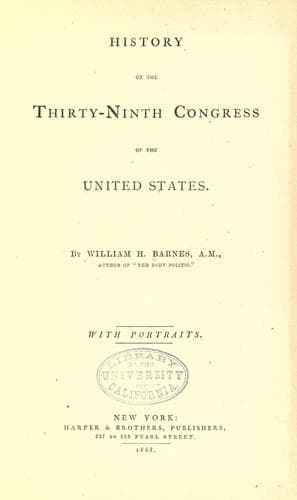
History of the Thirty-Ninth Congress of the United StatesBarnes, William Horatio
History
History of the Thirty-Ninth Congress of the United States
Barnes, William Horatio
United States -- Politics and government -- 1865-1869; United States. Congress (39th : 1865-1867)
"Sir, I can not see the justice of that doctrine. I assert that it is
the duty of the Government of the United States to provide proper
protection and to pay the costs attendant on it. We have gone out with
the strong arm of the Government and drawn from their homes, all over
this land, in obedience to the bond of allegiance which the Government
holds on the citizen, hundreds of thousands of men to the
battle-field; and yet, while we may exercise this extraordinary power,
the gentleman claims that we can not extend the protecting hand of the
Government to these men who have been battling for the life of the
nation, but can only send them, at their own cost, to juries for
verdicts of a few dollars in compensation for the most flagrant wrong
to their most sacred rights. Let those support that doctrine who will,
I can not."
At the conclusion of Mr. Wilson's speech, Mr. Eldridge, of Wisconsin,
moved to lay the whole subject on the table. This motion was
rejected--yeas, 32; nays, 118.
The House then rejected Mr. Bingham's proposed amendment, and
recommitted the bill to the Committee on the Judiciary.
On the 13th of March the bill was reported back from the committee
with some amendments, one of which was to strike out in section one
the following words:
"Without distinction of color, and there shall be no
discrimination in civil rights, or immunities among citizens
of the United States in any State or Territory of the United
States on account of race, color, or previous condition of
slavery."
The words were omitted to satisfy some who feared that it might be
held by the courts that the right of suffrage was conferred thereby.
Another amendment proposed was the addition of a section to the bill,
to-wit:
"_And be it further enacted_, That upon all questions of law
arising in any case under the provisions of this act, a
final appeal may be taken to the Supreme Court of the United
States."
Other amendments proposed and adopted were chiefly of a verbal
character.
The main question was finally taken, and the bill passed by the
following vote:
Public-domain text, read in full here on John Shaqi.
Reviews
Reviews
No reviews yet
Be the first to share your thoughts on this work.
Elsewhere in the archive
Join the Discussion
Join the discussion
Sign in to leave a comment or review.
Sign InorCreate an account