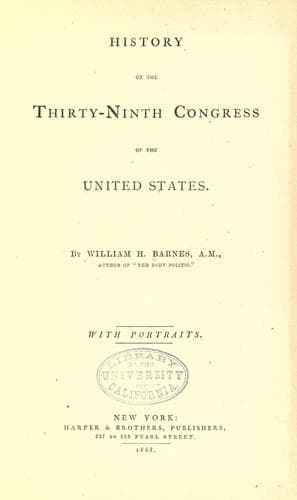
History of the Thirty-Ninth Congress of the United StatesBarnes, William Horatio
History
History of the Thirty-Ninth Congress of the United States
Barnes, William Horatio
United States -- Politics and government -- 1865-1869; United States. Congress (39th : 1865-1867)
"The gentleman from Ohio tells the House that civil rights involve all
the rights that citizens have under the Government; that in the term
are embraced those rights which belong to the citizen of the United
States as such, and those which belong to a citizen of a State as
such; and that this bill is not intended merely to enforce equality of
rights, so far as they relate to citizens of the United States, but
invades the States to enforce equality of rights in respect to those
things which properly and rightfully depend on State regulations and
laws. My friend is too sound a lawyer, is too well versed in the
Constitution of his country, to indorse that proposition on calm and
deliberate consideration. He knows, as every man knows, that this bill
refers to those rights which belong to men as citizens of the United
States and none other; and when he talks of setting aside the school
laws, and jury laws, and franchise laws of the States, by the bill now
under consideration, he steps beyond what he must know to be the rule
of construction which must apply here, and, as the result of which
this bill can only relate to matters within the control of Congress."
Comparing Mr. Bingham's proposed amendment with the original bill, Mr.
Wilson said: "What difference in principle is there between saying
that the citizen shall be protected by the legislative power of the
United States in his rights by civil remedy and declaring that he
shall be protected by penal enactments against those who interfere
with his rights? There is no difference in the principle involved. If
we may adopt the gentleman's mode, we may also select the mode
provided in this bill. There is a difference in regard to the expense
of protection; there is also a difference as to the effectiveness of
the two modes. Beyond this, nothing. This bill proposes that the
humblest citizen shall have full and ample protection at the cost of
the Government, whose duty it is to protect him. The amendment of the
gentleman recognizes the principle involved, but it says that the
citizen despoiled of his rights, instead of being properly protected
by the Government, must press his own way through the courts and pay
the bills attendant thereon. This may do for the rich, but to the
poor, who need protection, it is mockery. The highest obligation which
the Government owes to the citizen, in return for the allegiance
exacted of him, is to secure him in the protection of his rights.
Under the amendment of the gentleman, the citizen can only receive
that protection in the form of a few dollars in the way of damages, if
he shall be so fortunate as to recover a verdict against a solvent
wrong-doer. This is called protection. This is what we are asked to do
in the way of enforcing the bill of rights. Dollars are weighed
against the right of life, liberty, and property. The verdict of a
jury is to cover all wrongs and discharge the obligations of the
Government to its citizens.
Public-domain text, read in full here on John Shaqi.
Reviews
Reviews
No reviews yet
Be the first to share your thoughts on this work.
Elsewhere in the archive
Join the Discussion
Join the discussion
Sign in to leave a comment or review.
Sign InorCreate an account