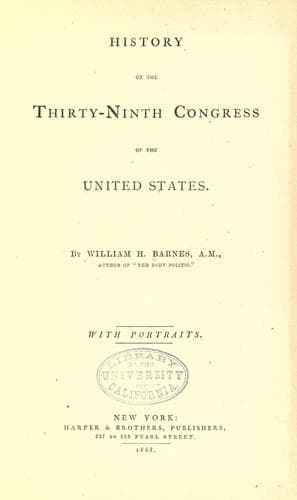
History of the Thirty-Ninth Congress of the United StatesBarnes, William Horatio
History
History of the Thirty-Ninth Congress of the United States
Barnes, William Horatio
United States -- Politics and government -- 1865-1869; United States. Congress (39th : 1865-1867)
On the 15th of March the amendments made by the House came before the
Senate for adoption in that body. While these were under consideration
by the Senate, Mr. Davis, of Kentucky, made two motions to amend,
which were rejected. He then moved to lay the bill on the table, and
was proceeding to make a speech, when he was informed that his motion
was not debatable. He then withdrew his motion to lay on the table,
and moved to postpone the bill until the first Monday of December
following. Finding that the last amendment proposed by the House of
Representatives was before the Senate, and that his motion could not
be entertained, he proceeded to make a speech on the question before
the Senate. He asserted that "Congress has no authority or
jurisdiction whatever" over the subject of legislation which the bill
contains. He closed his remarks with the following words: "I
therefore, on the grounds that I have stated, oppose this bill. I know
that they weigh nothing with the dominant power here. What care I for
that? What care I for the manner in which my suggestions may be
received by the majority? Nothing--less than nothing, if possible. I
am performing my duty according to my sense of that duty; and in
despite of all opposition, of frowns or scoffs, or of any other
opposition, come in what form it may, I will stand up to the last hour
of my service in this chamber, and will, endeavor, as best I can, to
perform my duty whatever may betide me."
The amendments of the House were agreed to, and the CIVIL RIGHTS BILL
wanted only Executive approval to become a law of the land.
CHAPTER XI.
THE CIVIL RIGHTS BILL, AND THE VETO.
Doubts as to the President's Decision -- Suspense ended --
The Veto Message -- Mr. Trumbull's Answer -- Mr. Reverdy
Johnson defends the Message -- Rejoinder -- Remarks of Mr.
Yates -- Mr. Cowan appeals to the Country -- Mr. Stewart
shows how States may make the Law a Nullity -- Mr. Wade --
Mr. McDougall on Persian Mythology -- Mr. J. H. Lane defends
the President -- Mr. Wade -- The President's Collar -- Mr.
Brown -- Mr. Doolittle -- Mr. Garrett Davis -- Mr. Saulsbury
-- Yeas and Nays in the Senate -- Vote in the House -- The
Civil Rights Bill becomes a Law.
The Civil Rights Bill having finally passed through Congress, on the
15th of March, by the concurrence of the Senate in the amendments of
the House, was submitted to the President for his approval. Much
anxiety was felt throughout the country to know what would be the fate
of the bill at the hands of the Executive. Some thought it incredible
that a President of the United States would veto so plain a
declaration of rights, essential to the very existence of a large
class of inhabitants. Others were confident that Mr. Johnson's
approval would not be given to a bill interfering, as they thought, so
flagrantly with the rights of the States under the Constitution.
Public-domain text, read in full here on John Shaqi.
Reviews
Reviews
No reviews yet
Be the first to share your thoughts on this work.
Elsewhere in the archive
Join the Discussion
Join the discussion
Sign in to leave a comment or review.
Sign InorCreate an account