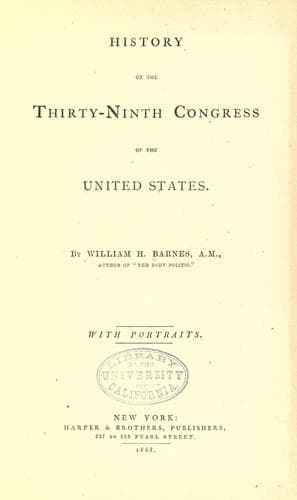
History of the Thirty-Ninth Congress of the United StatesBarnes, William Horatio
History
History of the Thirty-Ninth Congress of the United States
Barnes, William Horatio
United States -- Politics and government -- 1865-1869; United States. Congress (39th : 1865-1867)
All doubts were dispelled, on the 27th of March, by the appearance of
the President's Secretary on the floor of the Senate, who said, in
formal phrase: "Mr. President, I am directed by the President of the
United States to return to the Senate, in which house it originated,
the bill entitled 'An act to protect all persons in the United States
in their civil rights, and to furnish the means of their vindication,'
with his objections thereto in writing."
The Secretary of the Senate then read the message, which was heard
with profound attention by the Senators, and a large assembly which
thronged the galleries, drawn thither in anticipation of the
President's veto message.
"_To the Senate of the United States:_
"I regret that the bill which has passed both houses of
Congress, entitled 'An act to protect all persons in the
United States in their civil rights, and furnish the means
for their vindication,' contains provisions which I can not
approve, consistently with my sense of duty to the whole
people and my obligations to the Constitution of the United
States. I am therefore constrained to return it to the
Senate, the house in which it originated, with my objections
to its becoming a law.
"By the first section of the bill, all persons born in the
United States, and not subject to any foreign power,
excluding Indians not taxed, are declared to be citizens of
the United States. This provision comprehends the Chinese of
the Pacific States, Indians subject to taxation, the people
called Gypsies, as well as the entire race designated as
blacks, people of color, negroes, mulattoes, and persons of
African blood. Every individual of those races, born in the
United States, is by the bill made a citizen of the United
States. It does not purport to declare or confer any other
right of citizenship than Federal citizenship. It does not
purport to give these classes of persons any _status_ as
citizens of States, except that which may result from their
_status_ as citizens of the United States. The power to
confer the right of State citizenship is just as exclusively
with the several States as the power to confer the right of
Federal citizenship is with Congress.
Public-domain text, read in full here on John Shaqi.
Reviews
Reviews
No reviews yet
Be the first to share your thoughts on this work.
Elsewhere in the archive
Join the Discussion
Join the discussion
Sign in to leave a comment or review.
Sign InorCreate an account