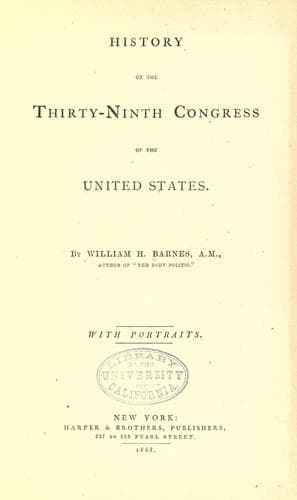
History of the Thirty-Ninth Congress of the United StatesBarnes, William Horatio
History
History of the Thirty-Ninth Congress of the United States
Barnes, William Horatio
United States -- Politics and government -- 1865-1869; United States. Congress (39th : 1865-1867)
"The bill, in effect, proposes a discrimination against
large numbers of intelligent, worthy, and patriotic
foreigners, and in favor of the negro, to whom, after long
years of bondage, the avenues to freedom and intelligence
have now been suddenly opened. He must, of necessity, from
his previous unfortunate condition of servitude, be less
informed as to the nature and character of our institutions
than he who, coming from abroad, has to some extent at
least, familiarized himself with the principles of a
Government to which he voluntarily intrusts 'life, liberty,
and the pursuit of happiness.' Yet it is now proposed by a
single legislative enactment to confer the rights of
citizens upon all persons of African descent, born within
the extended limits of the United States, while persons of
foreign birth, who make our land their home, must undergo a
probation of five years, and can only then become citizens
upon proof that they are of 'good moral character, attached
to the principles of the Constitution of the United States,
and well disposed to the good order and happiness of the
same.'
"The first section of the bill also contains an enumeration
of the rights to be enjoyed by these classes, so made
citizens, 'in every State and Territory in the United,
States.' These rights are, 'To make and enforce contracts,
to sue, be parties, and give evidence, to inherit, purchase,
lease, sell, hold, and convey real and personal property,'
and to have 'full and equal benefit of all laws and
proceedings for the security of persons and property as is
enjoyed by white citizens.' So, too, they are made subject
to the same punishment, pains, and penalties in common with
white citizens, and to none others. Thus a perfect equality
of the white and black races is attempted to be fixed by
Federal law, in every State of the Union, over the vast
field of State jurisdiction covered by these enumerated
rights. In no one of these can any State ever exercise any
power of discrimination between the different races.
"In the exercise of State policy over matters exclusively
affecting the people of each State, it has frequently been
thought expedient to discriminate between the two races. By
the statutes of some of the States, Northern as well as
Southern, it is enacted, for instance, that no white person
shall intermarry with a negro or mulatto. Chancellor Kent
says, speaking of the blacks, that 'marriages between them
and whites are forbidden in some of the States where slavery
does not exist, and they are prohibited in all the
slaveholding States, and when not absolutely contrary to
law, they are revolting, and regarded as an offense against
public decorum.'
Public-domain text, read in full here on John Shaqi.
Reviews
Reviews
No reviews yet
Be the first to share your thoughts on this work.
Elsewhere in the archive
Join the Discussion
Join the discussion
Sign in to leave a comment or review.
Sign InorCreate an account