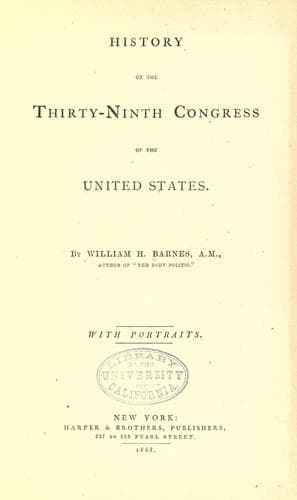
History of the Thirty-Ninth Congress of the United StatesBarnes, William Horatio
History
History of the Thirty-Ninth Congress of the United States
Barnes, William Horatio
United States -- Politics and government -- 1865-1869; United States. Congress (39th : 1865-1867)
"I do not say this bill repeals State laws on the subject of
marriage between the two races, for as the whites are
forbidden to intermarry with the blacks, the blacks can only
make such contracts as the whites themselves are allowed to
make, and therefore can not, under this bill, enter into the
marriage contract with the whites. I cite this
discrimination, however, as an instance of the State policy
as to discrimination, and to inquire whether, if Congress
can abrogate all State laws of discrimination between the
two races in the matter of real estate, of suits, and of
contracts generally, Congress may not also repeal the State
laws as to the contract of marriage between the two races?
Hitherto every subject embraced in the enumeration of rights
contained in this bill has been considered as exclusively
belonging to the States. They all relate to the internal
policy and economy of the respective States. They are
matters which in each State concern the domestic condition
of its people, varying in each according to its own peculiar
circumstances, and the safety and well-being of its own
citizens. I do not mean to say that upon all these subjects
there are not Federal restraints, as, for instance, in the
State power of legislation over contracts, there is a
Federal limitation that no State shall pass a law impairing
the obligations of contracts; and as to crimes, that no
State shall pass an _ex post facto_ law; and as to money,
that no State shall make any thing but gold and silver a
legal tender. But where can we find a Federal prohibition
against the power of any State to discriminate, as do most
of them, between aliens and citizens, between artificial
persons called corporations and natural persons, in the
right to hold real estate?
"If it be granted that Congress can repeal all State laws
discriminating between whites and blacks, in the subjects
covered by this bill, why, it may be asked, may not Congress
repeal in the same way all State laws discriminating between
the two races on the subject of suffrage and office? If
Congress can declare by law who shall hold lands, who shall
testify, who shall have capacity to make a contract in a
State, then Congress can by law also declare who, without
regard to color or race, shall have the right to sit as a
juror or as a judge, to hold any office, and, finally, to
vote, 'in every State and Territory of the United States.'
As respects the Territories, they come within the power of
Congress, for, as to them, the law-making power is the
Federal power; but as to the States, no similar provisions
exist, vesting in Congress the power 'to make rules and
regulations' for them.
Public-domain text, read in full here on John Shaqi.
Reviews
Reviews
No reviews yet
Be the first to share your thoughts on this work.
Elsewhere in the archive
Join the Discussion
Join the discussion
Sign in to leave a comment or review.
Sign InorCreate an account