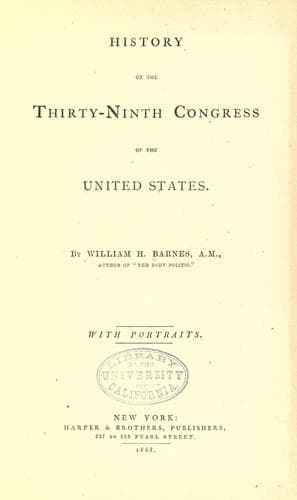
History of the Thirty-Ninth Congress of the United StatesBarnes, William Horatio
History
History of the Thirty-Ninth Congress of the United States
Barnes, William Horatio
United States -- Politics and government -- 1865-1869; United States. Congress (39th : 1865-1867)
"The legislation thus proposed invades the judicial power of
the State. It says to every State court or judge, If you
decide that this act is unconstitutional; if you refuse,
under the prohibition of a State law, to allow a negro to
testify; if you hold that over such a subject-matter the
State law is paramount, and 'under color' of a State law
refuse the exercise of the right to the negro, your error of
judgment, however conscientious, shall subject you to fine
and imprisonment. I do not apprehend that the conflicting
legislation which the bill seems to contemplate is so likely
to occur as to render it necessary at this time to adopt a
measure of such doubtful constitutionality.
"In the next place, this provision of the bill seems to be
unnecessary, as adequate judicial remedies could be adopted
to secure the desired end without invading the immunities of
legislators, always important to be preserved in the
interest of public liberty; without assailing the
independence of the judiciary, always essential to the
preservation of individual rights; and without impairing the
efficiency of ministerial officers, always necessary for the
maintenance of public peace and order. The remedy proposed
by this section seems to be, in this respect, not only
anomalous, but unconstitutional; for the Constitution
guarantees nothing with certainty, if it does not insure to
the several States the right of making and executing laws in
regard to all matters arising within their jurisdiction,
subject only to the restriction that, in cases of conflict
with the Constitution and constitutional laws of the United
States, the latter should be held to be the supreme law of
the land.
Public-domain text, read in full here on John Shaqi.
Reviews
Reviews
No reviews yet
Be the first to share your thoughts on this work.
Elsewhere in the archive
Join the Discussion
Join the discussion
Sign in to leave a comment or review.
Sign InorCreate an account