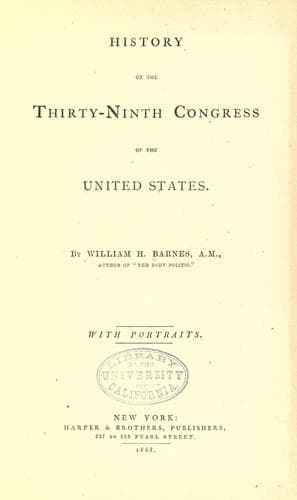
History of the Thirty-Ninth Congress of the United StatesBarnes, William Horatio
History
History of the Thirty-Ninth Congress of the United States
Barnes, William Horatio
United States -- Politics and government -- 1865-1869; United States. Congress (39th : 1865-1867)
"The third section gives the district courts of the United
States exclusive 'cognizance of all crimes and offenses
committed against the provisions of this act,' and
concurrent jurisdiction with the circuit courts of the
United States of all civil and criminal cases 'affecting
persons who are denied or can not enforce in the courts or
judicial tribunals of the State or locality where they may
be any of the rights secured to them by the first section.'
The construction which I have given to the second section is
strengthened by this third section, for it makes clear what
kind of denial or deprivation of the rights secured by the
first section was in contemplation. It is a denial or
deprivation of such rights 'in the courts or judicial
tribunals of the State.' It stands, therefore, clear of
doubt, that the offense and the penalties provided in the
second section are intended for the State judge, who, in the
clear exercise of his function as a judge, not acting
ministerially, but judicially, shall decide contrary to this
Federal law. In other words, when a State judge, acting upon
a question involving a conflict between a State law and a
Federal law, and bound, according to his own judgment and
responsibility, to give an impartial decision between the
two, comes to the conclusion that the State law is valid and
the Federal law is invalid, he must not follow the dictates
of his own judgment, at the peril of fine and imprisonment.
The legislative department of the Government of the United
States thus takes from the judicial department of the States
the sacred and exclusive duty of judicial decision, and
converts the State judge into a mere ministerial officer,
bound to decree according to the will of Congress.
"It is clear that, in States which deny to persons whose
rights are secured by the first section of the bill any one
of those rights, all criminal and civil cases affecting them
will, by the provisions of the third section, come under the
exclusive cognizance of the Federal tribunals. It follows
that if, in any State which denies to a colored person any
one of all those rights, that person should commit a crime
against the laws of the State--murder, arson, rape, or any
other crime--all protection and punishment through the
courts of the State are taken away, and he can only be tried
and punished in the Federal courts. How is the criminal to
be tried? If the offense is provided for and punished by
Federal law, that law, and not the State law, is to govern.
Public-domain text, read in full here on John Shaqi.
Reviews
Reviews
No reviews yet
Be the first to share your thoughts on this work.
Elsewhere in the archive
Join the Discussion
Join the discussion
Sign in to leave a comment or review.
Sign InorCreate an account