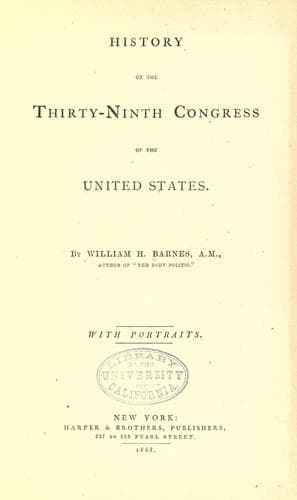
History of the Thirty-Ninth Congress of the United StatesBarnes, William Horatio
History
History of the Thirty-Ninth Congress of the United States
Barnes, William Horatio
United States -- Politics and government -- 1865-1869; United States. Congress (39th : 1865-1867)
"I do not propose to consider the policy of this bill. To me
the details of the bill seem fraught with evil. The white
race and the black race of the South have hitherto lived
together under the relation of master and slave--capital
owning labor. Now, suddenly, that relation is changed, and,
as to the ownership, capital and labor are divorced. They
stand, now, each master of itself. In this new relation, one
being necessary to the other, there will be a new
adjustment, which both are deeply interested in making
harmonious. Each has equal power in settling the terms, and,
if left to the laws that regulate capital and labor, it is
confidently believed that they will satisfactorily work out
the problem. Capital, it is true, has more intelligence; but
labor is never so ignorant as not to understand its own
interests, not to know its own value, and not to see that
capital must pay that value. This bill frustrates this
adjustment. It intervenes between capital and labor, and
attempts to settle questions of political economy through
the agency of numerous officials, whose interest it will be
to foment discord between the two races; for, as the breach
widens, their employment will continue, and when it is
closed, their occupation will terminate.
"In all our history, in all our experience as a people
living under Federal and State law, no such system as that
contemplated by the details of this bill has ever before
been proposed or adopted. They establish, for the security
of the colored race, safeguards which go infinitely beyond
any that the General Government has ever provided for the
white race. In fact, the distinction of race and color is,
by the bill, made to operate in favor of the colored and
against the white race. They interfere with the municipal
legislation of the States, with the relations existing
exclusively between a State and its citizens, or between
inhabitants of the same State--an absorption and assumption
of power by the General Government which, if acquiesced in,
must sap and destroy our federative system of limited
powers, and break down the barriers which preserve the
rights of the States. It is another step, or rather stride,
to centralization and the concentration of all legislative
power in the National Government. The tendency of the bill
must be to resuscitate the spirit of rebellion, and to
arrest the progress of those influences which are more
closely drawing around the States the bonds of union and
peace.
Public-domain text, read in full here on John Shaqi.
Reviews
Reviews
No reviews yet
Be the first to share your thoughts on this work.
Elsewhere in the archive
Join the Discussion
Join the discussion
Sign in to leave a comment or review.
Sign InorCreate an account