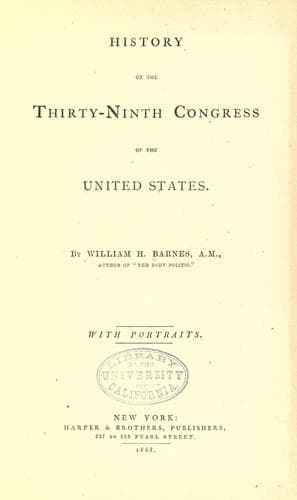
History of the Thirty-Ninth Congress of the United StatesBarnes, William Horatio
History
History of the Thirty-Ninth Congress of the United States
Barnes, William Horatio
United States -- Politics and government -- 1865-1869; United States. Congress (39th : 1865-1867)
"This extraordinary power is to be conferred upon agents
irresponsible to the Government and to the people, to whose
number the discretion of the commissioners is the only
limit, and in whose hands such authority might be made a
terrible engine of wrong, oppression, and fraud. The general
statutes regulating the land and naval forces of the United
States, the militia, and the execution of the laws, are
believed to be adequate for every emergency which can occur
in time of peace. If it should prove otherwise, Congress
can, at any time, amend those laws in such manner as, while
subserving the public welfare, not to jeopard the rights,
interests, and liberties of the people.
"The seventh section provides that a fee of ten dollars
shall be paid to each commissioner in every case brought
before him, and a fee of five dollars to his deputy, or
deputies, 'for each person he or they may arrest and take
before any such commissioner,' 'with such other fees as may
be deemed reasonable by such commissioner,' 'in general for
performing such other duties as may be required in the
premises.' All these fees are to be 'paid out of the
Treasury of the United States,' whether there is a
conviction or not; but, in case of conviction, they are to
be recoverable from the defendant. It seems to me that,
under the influence of such temptations, bad men might
convert any law, however beneficent, into an instrument of
persecution and fraud.
"By the eighth section of the bill, the United States
courts, which sit only in one place for white citizens, must
migrate, with the marshal and district attorney (and
necessarily with the clerk, although he is not mentioned),
to any part of the district, upon the order of the
President, and there hold a court 'for the purpose of the
more speedy arrest and trial of persons charged with a
violation of this act;' and there the judge and the officers
of the court must remain, upon the order of the President,
'for the time therein designated.'
"The ninth section authorizes the 'President, or such person
as he may empower for that purpose, to employ such part of
the land and naval forces of the United States, or of the
militia, as shall be necessary to prevent the violation and
enforce the due execution of this act.' This language seems
to imply a permanent military force, that is to be always at
hand, and whose only business is to be the enforcement of
this measure over the vast region where it is intended to
operate.
Public-domain text, read in full here on John Shaqi.
Reviews
Reviews
No reviews yet
Be the first to share your thoughts on this work.
Elsewhere in the archive
Join the Discussion
Join the discussion
Sign in to leave a comment or review.
Sign InorCreate an account