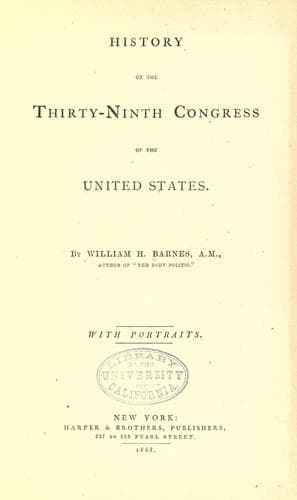
History of the Thirty-Ninth Congress of the United StatesBarnes, William Horatio
History
History of the Thirty-Ninth Congress of the United States
Barnes, William Horatio
United States -- Politics and government -- 1865-1869; United States. Congress (39th : 1865-1867)
The President had urged an objection that if Congress could confer
civil rights upon persons without regard to color or race, it might
also confer upon them political rights, and among them that of
suffrage. In reply to this, Mr. Trumbull referred to the policy of the
President himself in undertaking to "reoerganize State governments in
the disloyal States." He "claimed and exercised the power to protect
colored persons in their civil rights," and yet, when "urged to allow
loyal blacks to vote," he held that "he had no power; it was
unconstitutional."
"But, sir," continued Mr. Trumbull, "the granting of civil rights does
not and never did, in this country, carry with it rights, or, more
properly speaking, political privileges. A man may be a citizen in
this country without a right to vote or without a right to hold
office. The right to vote and hold office in the States depends upon
the legislation of the various States; the right to hold certain
offices under the Federal Government depends upon the Constitution of
the United States. The President must be a natural-born citizen, and a
Senator or Representative must be a citizen of the United States for a
certain number of years before he is eligible to a seat either in this
or the other House of Congress; so that the fact of being a citizen
does not necessarily qualify a person for an office, nor does it
necessarily authorize him to vote. Women are citizens; children are
citizens; but they do not exercise the elective franchise by virtue of
their citizenship. Foreigners, as is stated by the President in this
message, before they are naturalized are protected in the rights
enumerated in this bill, but because they possess those rights in
most, if not all, the States, that carries with it no right to vote.
"But, sir, what rights do citizens of the United States have? To be a
citizen of the United States carries with it some rights, and what are
they? They are those inherent, fundamental rights which belong to free
citizens or free men in all countries, such as the rights enumerated
in this bill, and they belong to them in all the States of the Union.
The right of American citizenship means something. It does not mean,
in the case of a foreigner, that when he is naturalized he is to be
left entirely to the mercy of State legislation. He has a right, when
duly naturalized, to go into any State of the Union, and to reside
there, and the United States Government will protect him in that
right. It will protect a citizen of the United States, not only in one
of the States of the Union, but it will protect him in foreign lands.
"Every person residing in the United States is entitled to the
protection of that law by the Federal Government, because the Federal
Government has jurisdiction of such questions. American citizenship
would be little worth if it did not carry protection with it.
Public-domain text, read in full here on John Shaqi.
Reviews
Reviews
No reviews yet
Be the first to share your thoughts on this work.
Elsewhere in the archive
Join the Discussion
Join the discussion
Sign in to leave a comment or review.
Sign InorCreate an account