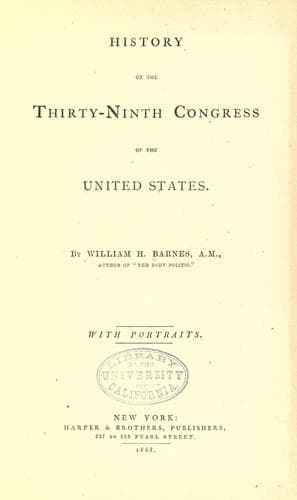
History of the Thirty-Ninth Congress of the United StatesBarnes, William Horatio
History
History of the Thirty-Ninth Congress of the United States
Barnes, William Horatio
United States -- Politics and government -- 1865-1869; United States. Congress (39th : 1865-1867)
"How is it that every person born in these United States owes
allegiance to the Government? Every thing that he is or has, his
property and his life, may be taken by the Government of the United
States in its defense, or to maintain the honor of the nation. And can
it be that our ancestors struggled through a long war and set up this
Government, and that the people of our day have struggled through
another war, with all its sacrifices and all its desolation, to
maintain it, and at last that we have got a Government which is
all-powerful to command the obedience of the citizen, but has no power
to afford him protection? Is that all that this boasted American
citizenship amounts to? Go tell it, sir, to the father whose son was
starved at Andersonville; or the widow whose husband was slain at
Mission Ridge; or the little boy who leads his sightless father
through the streets of your city, made blind by the winds and the sand
of the Southern coast; or the thousand other mangled heroes to be seen
on every side, that this Government, in defense of which the son and
the husband fell, the father lost his eyes, and the others were
crippled, had the right to call these persons to its defense, but has
no right to protect the survivors or their friends in any right
whatever in any of the States. Sir, it can not be. Such is not the
meaning of our Constitution. Such is not the meaning of American
citizenship. This Government, which would go to war to protect its
meanest--I will not say citizen--inhabitant, if you please, in any
foreign land, whose rights were unjustly encroached upon, has
certainly some power to protect its own citizens in their own country.
Allegiance and protection are reciprocal rights."
To the President's objection to the second section of the bill, that
it discriminated in favor of colored persons, Mr. Trumbull replied:
"It says, in effect, that no one shall subject a colored person to a
different punishment than that inflicted on a white person for the
same offense. Does that discriminate in favor of the colored person?
Why, sir, the very object and effect of the section is to prevent
discrimination, and language, it seems to me, could not more plainly
express that object and effect. It may be said that it is for the
benefit of the black man, because he is now, in some instances,
discriminated against by State laws; but that is the case with all
remedial statutes. They are for the relief of the persons who need the
relief, not for the relief of those who have the right already; and
when those needing the relief obtain it, they stand upon the precise
footing of those who do not need the benefit of the law."
The President had further objected to this section, that "it provides
for counteracting such forbidden legislation by imposing fine and
imprisonment upon the legislators who may pass such conflicting laws."
Public-domain text, read in full here on John Shaqi.
Reviews
Reviews
No reviews yet
Be the first to share your thoughts on this work.
Elsewhere in the archive
Join the Discussion
Join the discussion
Sign in to leave a comment or review.
Sign InorCreate an account