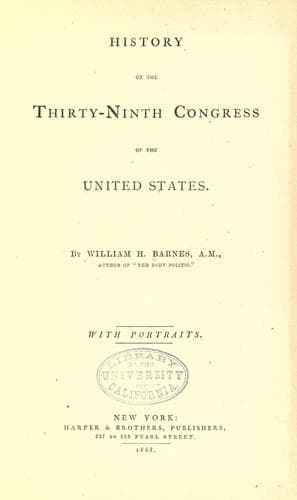
History of the Thirty-Ninth Congress of the United StatesBarnes, William Horatio
History
History of the Thirty-Ninth Congress of the United States
Barnes, William Horatio
United States -- Politics and government -- 1865-1869; United States. Congress (39th : 1865-1867)
"Congress, in the passage of the bill under consideration, sought no
controversy with the President. So far from it, the bill was proposed
with a view to carry out what were supposed to be the views of the
President, and was submitted to him before its introduction in the
Senate. I am not about to relate private declarations of the
President, but it is right that the American people should know that
the controversy which exists between him and Congress in reference to
this measure is of his own seeking. Soon after Congress met, it became
apparent that there was a difference of opinion between the President
and some members of Congress in regard to the condition of the
rebellious States and the rights to be secured to freedmen.
"The President, in his annual message, had denied the constitutional
power of the General Government to extend the elective franchise to
negroes, but he was equally decided in the assertion of the right of
every man to life, liberty, and the pursuit of happiness. This was his
language:
"'But while I have no doubt that now, after the close of the
war, it is not competent for the General Government to
extend the elective franchise in the several States, it is
equally clear that good faith requires the security of the
freedmen in their liberty and their property.'
"There were some members of Congress who expressed the opinion that in
the reoerganization of the rebellious States the right of suffrage
should be extended to the colored man, though this was not the
prevailing sentiment of Congress. All were anxious for a
reoerganization of the rebellious States, and their admission to full
participation in the Federal Government as soon as these relations
could be restored with safety to all concerned. Feeling the importance
of harmonious action between the different departments of the
Government, and an anxious desire to sustain the President, for whom I
had always entertained the highest respect, I had frequent interviews
with him during the early part of the session. Without mentioning any
thing said by him, I may with propriety state that, acting from the
considerations I have stated, and believing that the passage of a law
by Congress, securing equality in civil rights to freedmen and all
other inhabitants of the United States, when denied by State
authorities, would do much to relieve anxiety in the North, to induce
the Southern States to secure these rights by their own action, and
thereby remove many of the obstacles to an early reconstruction, I
prepared the bill substantially as it is now returned with the
President's objections. After the bill was introduced and printed, a
copy was furnished him, and at a subsequent period, when it was
reported that he was hesitating about signing the Freedmen's Bureau
Bill, he was informed of the condition of the Civil Rights Bill then
pending in the House, and a hope expressed that if he had objections
Public-domain text, read in full here on John Shaqi.
Reviews
Reviews
No reviews yet
Be the first to share your thoughts on this work.
Elsewhere in the archive
Join the Discussion
Join the discussion
Sign in to leave a comment or review.
Sign InorCreate an account