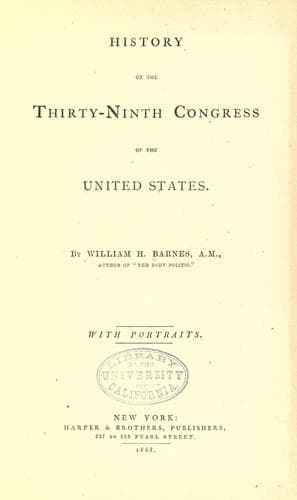
History of the Thirty-Ninth Congress of the United StatesBarnes, William Horatio
History
History of the Thirty-Ninth Congress of the United States
Barnes, William Horatio
United States -- Politics and government -- 1865-1869; United States. Congress (39th : 1865-1867)
to any of its provisions he would make them known to its friends, that
they might be remedied, if not destructive of the measure; that there
was believed to be no disposition on the part of Congress, and
certainly none on my part, to have bills presented to him which he
could not approve. He never indicated to me, nor, so far as I know, to
any of its friends, the least objection to any of the provisions of
the bill till after its passage. And how could he, consistently with
himself? The bill was framed, as was supposed, in entire harmony with
his views, and certainly in harmony with what he was then and has
since been doing in protecting freedmen in their civil rights all
through the rebellious States. It was strictly limited to the
protection of the civil rights belonging to every freeman, the
birthright of every American citizen, and carefully avoided conferring
or interfering with political rights or privileges of any kind.
* * * * "If the bill now before us, and which goes no further than to
secure civil rights to the freedman, can not be passed, then the
constitutional amendment proclaiming freedom to all the inhabitants of
the land is a cheat and a delusion.
"I can not better conclude what I have to say than in the language of
Mr. Johnson on the occasion of the veto of the Homestead Bill, when,
after stating that the fact that the President was inconsistent and
changed his opinion with reference to a great measure and a great
principle, is no reason why a Senator or Representative, who has acted
understandingly, should change his opinion. He said:
"'I hope the Senate and House of Representatives, who have
sanctioned this bill by more than a two-thirds majority,
will, according to the Constitution, exercise their
privilege and power, and let the bill become a law of the
land, according to the high behest of the American people.'"
Public-domain text, read in full here on John Shaqi.
Reviews
Reviews
No reviews yet
Be the first to share your thoughts on this work.
Elsewhere in the archive
Join the Discussion
Join the discussion
Sign in to leave a comment or review.
Sign InorCreate an account