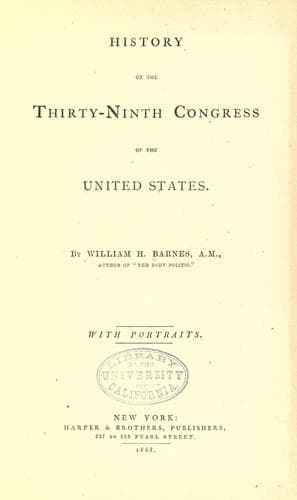
History of the Thirty-Ninth Congress of the United StatesBarnes, William Horatio
History
History of the Thirty-Ninth Congress of the United States
Barnes, William Horatio
United States -- Politics and government -- 1865-1869; United States. Congress (39th : 1865-1867)
On the next day, April 5th, Mr. Johnson, of Maryland, made a speech
sustaining the Veto Message. He argued that negroes were not citizens
of the United States by reason of their birth in the United States,
and that Congress had no authority by law to declare them such. To
sustain his position, he made quotations from the opinion of the
minority in the Dred Scott case, as rendered by Mr. Justice Curtis. He
then proceeded to reply to some of Mr. Trumbull's arguments against
the Veto Message: "The honorable member from Illinois disposes of the
President's objection to the first section of this bill by saying that
it is merely declaratory. I know it is competent for any legislative
body, on a question where difference of opinions exist in relation to
any legal proposition, to remove them by declaratory legislation; but
that is not the purpose of this bill. It professes to be passed in the
exercise of a positive and absolute power to change the law--not to
declare what the law was in order to remove doubts, but to make the
law. It assumes, or otherwise there would be no occasion for it, that
birth alone does not confer citizenship; and assuming that no
citizenship would exist in consequence of birth alone, it declares
that birth alone, in spite of State constitution and State laws, shall
confer citizenship. Now, with all deference to the opinion of the
honorable Chairman of the Committee on the Judiciary, that seems to me
to be a proposition as clearly erroneous as any proposition can be in
relation to constitutional law. The States were sovereign before the
Constitution was adopted; and the Constitution not only, according to
its very terms, does not profess to confer upon the Government of the
United States all governmental power, but as far as Congress is
concerned, professes to confer upon that department of the Government
only the particular delegated powers there enumerated; but so anxious
were the framers of that instrument and the great men of that day, to
whom the subsequent organization of this Government was left, that
although they had no doubt as to the principle that only the delegated
powers were granted, (and the debates in the Convention itself as well
as the debates in the conventions of the several States, when the
Constitution was before them for adoption or rejection, all went upon
the theory that no powers were conferred except such as were expressly
granted, or as were reasonably implied to be as necessary to carry out
the powers expressly granted,) by the tenth amendment adopted recently
after the Constitution went into operation, and recommended by the
men, many of whom were the framers of the Constitution itself, that
the powers not delegated by the Constitution, and not denied to the
States by the same instrument, were to be considered reserved to the
States respectively, or to the people.
Public-domain text, read in full here on John Shaqi.
Reviews
Reviews
No reviews yet
Be the first to share your thoughts on this work.
Elsewhere in the archive
Join the Discussion
Join the discussion
Sign in to leave a comment or review.
Sign InorCreate an account