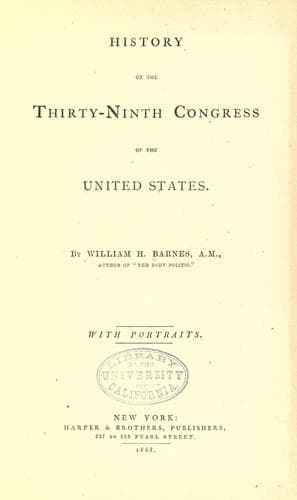
History of the Thirty-Ninth Congress of the United StatesBarnes, William Horatio
History
History of the Thirty-Ninth Congress of the United States
Barnes, William Horatio
United States -- Politics and government -- 1865-1869; United States. Congress (39th : 1865-1867)
"'While they [negroes] were slaves, it was a very different
question; but now, when slavery is terminated, and by
terminating it you have got rid of the only obstacle in the
way of citizenship, two questions arise: first, Whether that
fact itself does not make them citizens? Before they were
not citizens, because of slavery, and only because of
slavery. Slavery abolished, why are they not just as much
citizens as they would have been had slavery never existed?
My opinion is that they become citizens, and I hold that
opinion so strongly that I should consider it unnecessary to
legislate on the subject at all, as far as that class is
concerned, but for the ruling of the Supreme Court, to which
I have adverted.'
"Sir, that opinion was held by the honorable Senator from Maryland who
made this speech to-day. He holds the opinion so strongly now that
slavery is abolished, which was the only obstacle in the way of their
being citizens, that he would want no legislation on the subject but
for the Dred Scott decision! What further did the Senator from
Maryland say less than ninety days ago? It is possible, doubtless--it
is not only possible but it is certainly true--that the Senator from
Maryland, by reading the conclusive arguments of the Veto Message in
regard to Chinese and Gypsies, has discovered that he was in error
ninety days ago. I by no means mean to impute any wrong motive to the
Senator from Maryland, but simply to ask that he will pardon me if I
have not been able to see the conclusive reasoning of the Veto
Message."
After quoting still further from Mr. Johnson's speech, made on a
previous occasion, Mr. Trumbull said: "But as I am up, I will refer to
one other point to which the Senator alluded, and that is in regard to
the quotation which I made yesterday from the statute of 1790. I
quoted that statute for the purpose of showing that the provisions in
the bill under consideration, which it was insisted allowed the
punishment of ministerial officers and judges who should act in
obedience to State laws and under color of State laws, were not
anomalous. I read a statute of 1790 to show that the Congress of the
United States, at that day, provided for punishing both judges and
officers who acted under color of State law in defiance of a law of
the United States. How does the Senator answer that? He says that was
on a different subject; the law of 1790 provided for punishing judges
and officers who did an act in violation of the international law,
jurisdiction over which is conferred upon the nation. Let me ask the
Senator from Maryland, if the bill under discussion does not provide
for the punishment of persons who violate a right secured by the
Constitution of the United States? Is a right which a citizen holds by
virtue of the Constitution of his country less sacred than a right
which he holds by virtue of international law?"
Public-domain text, read in full here on John Shaqi.
Reviews
Reviews
No reviews yet
Be the first to share your thoughts on this work.
Elsewhere in the archive
Join the Discussion
Join the discussion
Sign in to leave a comment or review.
Sign InorCreate an account