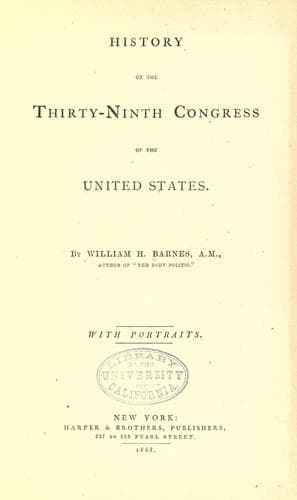
History of the Thirty-Ninth Congress of the United StatesBarnes, William Horatio
History
History of the Thirty-Ninth Congress of the United States
Barnes, William Horatio
United States -- Politics and government -- 1865-1869; United States. Congress (39th : 1865-1867)
Mr. Johnson replied as follows: "It is singular, in my estimation, how
a gentleman with a mind as clear as Mr. Trumbull's, with a
perspicacity that is a little surprising, could have fallen into the
error of supposing that there is any inconsistency between the
doctrine contained in the speech to which he has adverted and the one
which I have maintained to-day. What I said then I say now, that as
far as the United States are concerned, all persons born within the
limits of the United States are to be considered as citizens, and that
without reference to the color or the race; and after the abolition of
slavery the negro would stand precisely in the condition of the white
man. But the honorable member can hardly fail, I think--certainly he
can not when I call his attention to it--to perceive that that has
nothing to do with the question now before the Senate. His bill makes
them citizens of the United States because of birth, and gives them
certain rights within the States."
Mr. Fessenden asked: "Were not your remarks made on this very question
in this bill?"
"No," replied Mr. Johnson; "on another bill." He continued: "What I
maintain is this--and I have never doubted it, because I entertained
the same opinion when I made those remarks that I entertain now--that
citizenship of the United States, in consequence of birth, does not
make a party a citizen of the State in which he is born unless the
Constitution and laws of the State recognize him as a citizen. Now,
what does this bill propose? All born within the United States are to
be considered citizens of the United States, and as such shall have in
every State all the rights that belong to any body else in the State
as far as the particular subjects stated in the bill are concerned.
Now, I did suppose, and I shall continue to suppose, it to be clear,
unless I am met with the almost paramount authority of the Chairman of
the Judiciary Committee, that citizenship, by way of birth, conferred
on the party as far as he and the United States were concerned, is not
a citizenship which entitles him to the privilege of citizenship
within the State where he is born; if it be true, and I submit that it
is true beyond all doubt, that over the question of State citizenship
the authority of the State Government is supreme.
"Now, the honorable member is confounding the _status_ of a citizen of
the United States and the _status_ of a citizen of the United States
who as such is a citizen of the State of his residence. Maintaining,
as I do, that there is no authority to make any body a citizen of the
United States so as to convert him thereby into a citizen of a State,
there is no authority in the Constitution for this particular bill,
which says that because he is a citizen of the United States he is to
be considered a citizen of any State in which he may be at any time
with reference to the rights conferred by this bill."
Public-domain text, read in full here on John Shaqi.
Reviews
Reviews
No reviews yet
Be the first to share your thoughts on this work.
Elsewhere in the archive
Join the Discussion
Join the discussion
Sign in to leave a comment or review.
Sign InorCreate an account