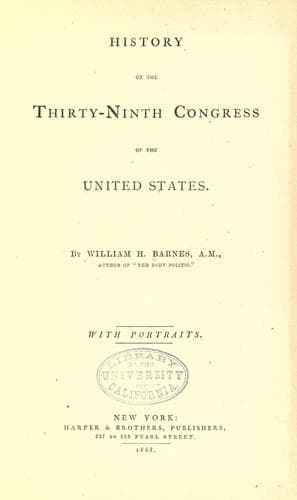
History of the Thirty-Ninth Congress of the United StatesBarnes, William Horatio
History
History of the Thirty-Ninth Congress of the United States
Barnes, William Horatio
United States -- Politics and government -- 1865-1869; United States. Congress (39th : 1865-1867)
Mr. Trumbull replied: "I desire simply to remark that the speech from
which I quoted, made by the Senator from Maryland, was made upon this
very bill. It was in reference to this bill that he was speaking when
he laid down the proposition that every person born in the United
States since the abolition of slavery was a citizen of the United
States, and if there was any doubt about it, it was proper for us to
declare them so, and not only proper, but our duty to do so; and to
make the matter specific, the honorable Senator voted for this
proposition, which I will now read, on the yeas and nays:
"'All persons born in the United States, and not subject to
any foreign Power, excluding Indians not taxed, are hereby
declared to be citizens of the United States, without
distinction of color.'
"Upon the adoption of that proposition as an amendment, it not being
in the bill as originally introduced, the Senator from Maryland, with
thirty others, voted in the affirmative. So we have his high authority
for saying that all persons born in the United States, and not subject
to any foreign Power, are citizens of the United States, exactly as it
appears in this bill."
"Mr. Yates, of Illinois, remarked: "I remember very well that the
Senator from Maryland offered an amendment to the Freedmen's Bureau
Bill to this effect: to strike out the words 'without distinction of
color.' The Freedmen's Bureau Bill applied legislation by Congress to
the freedmen in the States and to the condition of the freedmen in the
States. It was legislation that affected the freedmen in the
rebellious States. If I remember aright the Senator from Maryland
moved to strike out the words 'without distinction of color' in one
section of that bill, and for that motion he gave this reason:
because, under the Constitution of the United States, as amended,
abolishing slavery in all the States and Territories of the United
States, the freedmen occupied precisely the same position with any
other citizen of the United States in any State or Territory. I
understood him as taking the broad position, which I have maintained,
and which Republican Senators have maintained, and which I think the
country maintains, that under the Constitution, as amended, the
freedman occupies precisely the same position as any man born in any
State or Territory of the United States; and that was the object, if I
understood the Senator from Maryland, of his moving to amend the
Freedmen's Bureau Bill by striking out the words 'without distinction
of color.'
"I recognize the authority of the decisions quoted by the Senator from
Maryland before the adoption of the amendment to the Constitution. The
States had the power over the question of slavery in the States before
the amendment to the Constitution; but by the amendment to the
Constitution, in which the States have concurred, the freedman becomes
a free man, entitled to the same rights and privileges as any other
citizen of the United States."
Public-domain text, read in full here on John Shaqi.
Reviews
Reviews
No reviews yet
Be the first to share your thoughts on this work.
Elsewhere in the archive
Join the Discussion
Join the discussion
Sign in to leave a comment or review.
Sign InorCreate an account