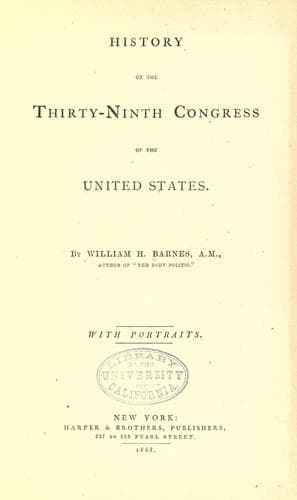
History of the Thirty-Ninth Congress of the United StatesBarnes, William Horatio
History
History of the Thirty-Ninth Congress of the United States
Barnes, William Horatio
United States -- Politics and government -- 1865-1869; United States. Congress (39th : 1865-1867)
"There is another provision of the bill, which, notwithstanding the
act of Congress relied upon by the honorable Senator from Illinois, I
think is unquestionably anomalous, and to me not only anomalous, but
atrocious; and that is, the substitution of an indictment for the writ
of error. What has been the law of these United States heretofore?
When an act of Congress came in contact with a State law, and the
judge of a State court decided that the law of Congress was
unconstitutional, there was an appeal given to the debated party to
the Supreme Court of the United States in order to determine the
constitutionality of the law. But, sir, who, until the last few
months, ever heard of making the judge a criminal because he decided
against the constitutionality of a law of the United States? One would
think we were being transported back to the dark ages of the world
when a man is to be accused and perhaps convicted of a crime who has
done nothing more than honestly and conscientiously discharged his
duty. I know that the persons of embassadors are sacred, and I know
that it is a very high offense against the law of nations, which no
civil judge of any court could justify, to invade this sacred right of
the embassador, but every body knows that that is an exceptional case.
Every body knows that in all times and at all ages the judge was
punishable who did not respect the person of an embassador. But that
is not this case. That analogy will not help the third section of this
bill. It is openly avowed upon the floor of the Senate of the United
States, in the year of our Lord 1866, in the full blaze and light of
the nineteenth century, that the indictment is to be a substitute for
the writ of error, and it is justified because a judge ought to be
indicted who violates the sacred person of an embassador! What potency
there must be in the recent amendment of the Constitution which has
foisted the negro and set him upon the same platform as the envoy
extraordinary and minister plenipotentiary of Great Britain or of all
the Russias to the United States of America, and made him as sacred as
an embassador, and the judge who decides against him is to be punished
as a criminal!"
Public-domain text, read in full here on John Shaqi.
Reviews
Reviews
No reviews yet
Be the first to share your thoughts on this work.
Elsewhere in the archive
Join the Discussion
Join the discussion
Sign in to leave a comment or review.
Sign InorCreate an account