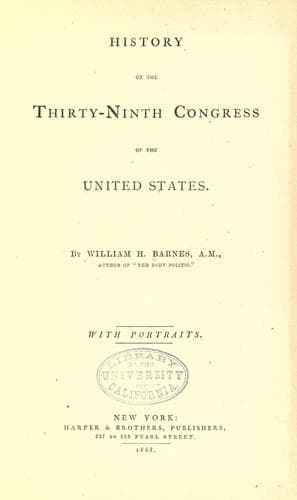
History of the Thirty-Ninth Congress of the United StatesBarnes, William Horatio
History
History of the Thirty-Ninth Congress of the United States
Barnes, William Horatio
United States -- Politics and government -- 1865-1869; United States. Congress (39th : 1865-1867)
Mr. Stewart showed that States might easily avoid all the annoying
operations of this bill which were feared by its opponents: "When I
reflect how very easy it is for the States to avoid the operation of
this bill, how very little they have to do to avoid the operation of
the bill entirely, I think that it is robbed of its coercive features,
and I think no one has any reason to complain because Congress has
exercised a power, which it must be conceded it has, when it has
exercised it in a manner which leaves it so easy for the States to
avoid the operation of this bill. If passed to-day, it has no
operation in the State of Georgia; it is impossible to commit a crime
under this bill in the State of Georgia; and the other States can
place themselves in the same position so easily that I do not believe
they ought to complain."
He then read the second section of an act passed in Georgia, precisely
similar to the first section of the Civil Eights Bill. Nothing could
be done in Georgia under "color of law," which would subject officers
to the penalties provided by the Civil Rights Bill. "It being so
easily avoided by being complied with, by doing a simple act of
justice, by carrying out the spirit of the constitutional amendment, I
can not give my consent to defeat a bill the purpose of which is good,
the operation of which is so innocent, and may be so easily avoided."
The Republican Senators were desirous of bringing the bill to a final
vote on this evening, but on account of the illness of Senator Wright,
of New Jersey, it was proposed by Democratic members to appoint some
hour on the following day when the vote should be taken in order that
they might have a full vote.
Mr. Wade, of Ohio, said: "If this was a question in the ordinary
course of legislation, I certainly would not object to the proposition
which the gentlemen on the other side make; but I view it as one of
the greatest and most fundamental questions that has ever come before
this body for settlement, and I look upon it as having bearings
altogether beyond the question on this bill. The bill is, undoubtedly,
a very good one. There is no constitutional objection to it; there has
been no objection to it raised that creates a doubt in the mind of any
mortal man; but, nevertheless, we are at issue with the President of
the United States upon a question peculiarly our own. The President of
the United States has no more power under the Constitution to
interpose his authority here, to prescribe the principle upon which
these States should be admitted to this Union, than any man of this
body has out of it. The Constitution makes him the executive of the
laws that we make, and there it leaves him; and what is our condition?
We who are to judge of the forms of government under which States
shall exist; we, who are the only power that is charged with this
great question, are to be somehow or other wheedled out of it by the
President by reason of the authority that he sets up.
Public-domain text, read in full here on John Shaqi.
Reviews
Reviews
No reviews yet
Be the first to share your thoughts on this work.
Elsewhere in the archive
Join the Discussion
Join the discussion
Sign in to leave a comment or review.
Sign InorCreate an account