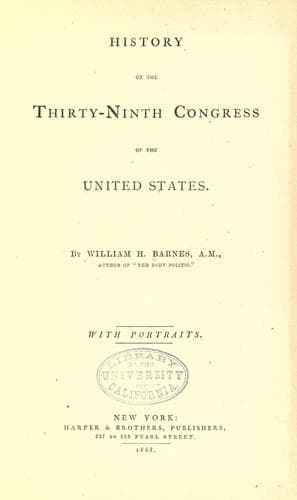
History of the Thirty-Ninth Congress of the United StatesBarnes, William Horatio
History
History of the Thirty-Ninth Congress of the United States
Barnes, William Horatio
United States -- Politics and government -- 1865-1869; United States. Congress (39th : 1865-1867)
"Sir, we can not abandon it unless we yield to a principle that will
unhinge and unsettle the balances of the Constitution itself. If the
President of the United States can interpose his authority upon a
question of this character, and can compel Congress to succumb to his
dictation, he is an emperor, a despot, and not a President of the
United States. Because I believe the great question of congressional
power and authority is at stake here, I yield to no importunities of
the other side. I feel myself justified in taking every advantage
which the Almighty has put into my hands to defend the power and
authority of this body, of which I claim to be a part. I will not
yield to these appeals of comity on a question like this; but I will
tell the President and every body else that, if God Almighty has
stricken one member so that he can not be here to uphold the dictation
of a despot, I thank him for his interposition, and I will take
advantage of it if I can."
Mr. McDougall, of California, replied to Mr. Wade. This wayward
Senator from California has wide notoriety from his unhappy habits of
intemperance. He has been described by a writer unfriendly to his
politics as "the most brilliant man in the Senate; a man so
wonderfully rich, that though he seeks to beggar himself in talents
and opportunities, he has left a patrimony large enough to outdazzle
most of his colleagues." He frequently would enter the Senate-chamber
in a condition of apparent stupor, unable to walk straight; and after
listening a few moments to what was going on, has arisen and spoken
upon the pending question in words of great beauty and force.
On this occasion Mr. McDougall is described as having been in a worse
condition than usual. His words were muttered rather than spoken, so
that only those immediately about him could hear; and yet his remarks
were termed by one of his auditors as "one of the neatest little
speeches ever heard in the Senate." His remarks were as follows: "The
Senator from Ohio is in the habit of appealing to his God in
vindication of his judgment and conduct; it is a common thing for him
to do so; but in view of the present demonstration, it may well be
asked who and what is his God. In the old Persian mythology there was
an Ormudz and an Ahriman--a god of light and beauty, and a god of
darkness and death. The god of light sent the sun to shine, and gentle
showers to fructify the fields; the god of darkness sent the tornado,
and the tempest, and the thunder, scathing with pestilence the
nations. And in old Chaldean times men came to worship Ahriman, the
god of darkness, the god of pestilence and famine; and his priests
became multitudinous; they swarmed the land; and when men prayed then
their offerings were, 'We will not sow a field of grain, we will not
dig a well, we will not plant a tree.' These were the offerings to the
dark spirit of evil, until a prophet came who redeemed that ancient
land; but he did it after crucifixion, like our great Master.
Public-domain text, read in full here on John Shaqi.
Reviews
Reviews
No reviews yet
Be the first to share your thoughts on this work.
Elsewhere in the archive
Join the Discussion
Join the discussion
Sign in to leave a comment or review.
Sign InorCreate an account