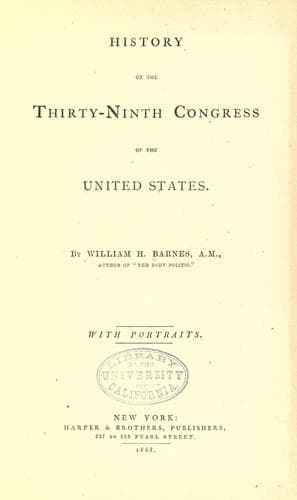
History of the Thirty-Ninth Congress of the United StatesBarnes, William Horatio
History
History of the Thirty-Ninth Congress of the United States
Barnes, William Horatio
United States -- Politics and government -- 1865-1869; United States. Congress (39th : 1865-1867)
He endeavored to explain his position and changes of opinion upon the
Civil Rights: "While this measure was upon its passage, I took no part
in its discussion except upon a single point in relation to the Indian
tribes. The bill passed, and the final vote was taken when I was not
present in the Senate; but it was not under such circumstances that,
had I been here, I should not have voted for the bill. I have no doubt
that if I had been present I should have voted for it. My attention
was not drawn very earnestly to the consideration of all the
provisions of this bill until the bill had passed from Senate and had
gone to the House of Representatives, when the speeches of Mr.
Bingham, of Ohio, and of Mr. Delano, of Ohio, both able and
distinguished lawyers of that State, arrested my attention and called
me very carefully to the consideration of the great questions which
are involved in the bill. The bill was passed by the House of
Representatives; it went to the President. From the fact that it was
not signed and returned to this body at once, and from all I heard, I
became satisfied that, at least, if the bill was not to be returned
with objections, it was being withheld for most earnest and serious
consideration by the Executive.
"Then, Mr. President, it was, in view of all that had occurred, what
had been said by gentlemen in whom I had the utmost--I may say
unbounded--confidence, that I began to look into this measure and to
study it for myself. It is not my purpose now to go into a discussion
of the provisions of this bill any further than to say that there are
provisions in it upon which the judgments of the best patriots, the
best jurists, the most earnest men disagree. There are men, in whom I
have entire confidence, who maintain that all its provisions are
within the purview of the Constitution; there are others in whom I
have confidence, and equal confidence, who maintain directly the
contrary; and this has brought me seriously to consider whether there
be no common ground upon which friends can stand and stand together.
Sir, I may have failed to find it; but if I have, it is not because I
have not most earnestly sought for it with some days of study and most
earnest reflection. I have endeavored to put upon paper what I believe
would carry this constitutional provision into effect and yet would be
a common ground on which we could unite without violating the
conscientious convictions of any."
Public-domain text, read in full here on John Shaqi.
Reviews
Reviews
No reviews yet
Be the first to share your thoughts on this work.
Elsewhere in the archive
Join the Discussion
Join the discussion
Sign in to leave a comment or review.
Sign InorCreate an account