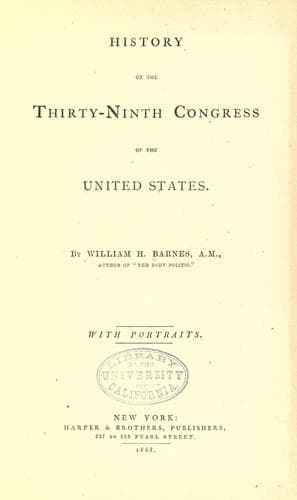
History of the Thirty-Ninth Congress of the United StatesBarnes, William Horatio
History
History of the Thirty-Ninth Congress of the United States
Barnes, William Horatio
United States -- Politics and government -- 1865-1869; United States. Congress (39th : 1865-1867)
In concluding his remarks, Mr. Doolittle referred to instructions
received by him from the Legislature of Wisconsin: "Mr. President, I
have received, in connection with my colleague, a telegraphic dispatch
from the Governor of the State of Wisconsin, which I have no doubt is
correct, although I have not seen the resolution which is said to have
been passed by the Legislature, in which it is stated that the
Legislature has passed a resolution instructing the Senators in
Congress from Wisconsin to vote for the passage of the Senate bill
commonly known as the Civil Rights Bill, the veto of the President to
the contrary notwithstanding. I have already stated, from my
stand-point, the reasons why, in my judgment, I can not do it; I have
stated them freely and frankly, and, as a matter of course, I expect
to abide the consequences. I know that it has sometimes been said to
me, by those, too, in whom I would have confidence, that for me, under
circumstances like these, not to follow the instructions of the
Legislature of my State, would be to terminate my political life. Sir,
be it so. I never held or aspired to any other office politically than
the one I now hold; and God knows, if I know my own heart, if I can
see this Union restored after this gigantic war which has put down the
rebellion, and to which I have lent my support, I shall be satisfied.
I do not desire to remain in political life beyond that hour. There is
nothing in that which will have the slightest influence whatever upon
me. The duty which I owe to myself, the duty which I owe to the
country, the duty which I owe to the union of these States, and the
preservation of the rights of the States, and the duty which I owe to
the great Republican party, which I would still desire to save,
prompts me to pursue the course which I now do."
Mr. Garrett Davis, of Kentucky, addressed the Senate in a long speech,
of which the following is the closing paragraph: "Public justice is
often slow, but generally sure. Think you that the people will look on
with folded arms and stolid indifference and see you subvert their
Constitution and liberties, and on their ruins erect a grinding
despotism. No; erelong they will rise up with earthquake force and
fling you from power and place. I commend to your serious meditation
these words: 'Go tell Sylla that you saw Caius Marius sitting upon the
ruins of Carthage!'"
Public-domain text, read in full here on John Shaqi.
Reviews
Reviews
No reviews yet
Be the first to share your thoughts on this work.
Elsewhere in the archive
Join the Discussion
Join the discussion
Sign in to leave a comment or review.
Sign InorCreate an account