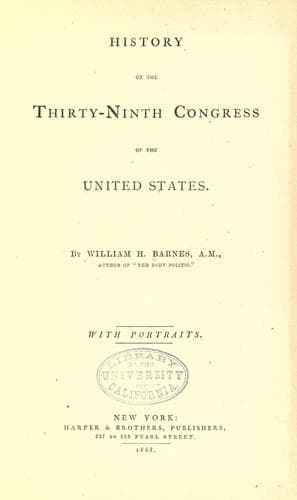
History of the Thirty-Ninth Congress of the United StatesBarnes, William Horatio
History
History of the Thirty-Ninth Congress of the United States
Barnes, William Horatio
United States -- Politics and government -- 1865-1869; United States. Congress (39th : 1865-1867)
"SEC. 10. _And be it further enacted_, That upon all
questions of law arising in any cause under the provisions
of this act a final appeal may be taken to the Supreme Court
of the United States."
CHAPTER XII.
THE SECOND FREEDMEN'S BUREAU BILL BECOMES A LAW.
The Discovery of the Majority -- The Senate Bill -- The
House Bill -- Its Provisions -- Passage of the Bill --
Amendment and Passage in the Senate -- Committee of
Conference -- The Amendments as Accepted -- The Bill as
Passed -- The Veto -- The Proposition of a Democrat Accepted
-- Confusion in Leadership -- Passage of the Bill over the
Veto -- It Becomes a Law.
Congress having succeeded in placing the Civil Rights Bill in the
statute-book in spite of Executive opposition, was not disposed to
allow other legislation which was regarded as important to go by
default. The disposition of the President, now plainly apparent, to
oppose all legislation which the party that had elevated him to office
might consider appropriate to the condition of the rebel States, the
majority in Congress discovered that, if they would make progress in
the work before them, they must be content to do without Executive
approval. The defection of the President from the principles of the
party which had elected him, so far from dividing and destroying that
party, had rather given it consolidation and strength. After the veto
of the Civil Rights Bill, a very few members of the Senate and House
of Representatives who had been elected as Republicans adhered to the
President, but the most of those who had wavered stepped forward into
the ranks of the "Radicals," as they were called, and a firm and
invincible "two-thirds" moved forward to consummate legislation which
they deemed essential to the interests of the nation.
So fully convinced were the majority that some effective legislation
for the freedmen should be consummated, that two days after the final
vote in which the former bill failed to pass over the veto, Senator
Wilson introduced a bill "to continue in force the Bureau for the
relief of Freedmen and Refugees," which was read twice and referred to
the Committee on Military Affairs.
The bill, however, which subsequently became a law, originated in the
House of Representatives. In that branch of Congress was a Special
Committee on the Freedmen, who were able to give more immediate and
continuous attention to that class of people than could committees
such as those of the Judiciary and Military Affairs, having many other
subjects to consider.
The Committee on the Freedmen, having given much time and attention to
the perfection of a measure to meet the necessities of the case, on
the 22d of May reported through their chairman, Mr. Eliot, "A bill to
continue in force and amend an act entitled 'an act to establish a
Bureau for the relief of Freedmen and Refugees, and for other
purposes.'"
Public-domain text, read in full here on John Shaqi.
Reviews
Reviews
No reviews yet
Be the first to share your thoughts on this work.
Elsewhere in the archive
Join the Discussion
Join the discussion
Sign in to leave a comment or review.
Sign InorCreate an account