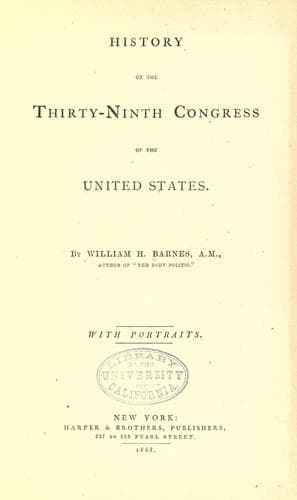
History of the Thirty-Ninth Congress of the United StatesBarnes, William Horatio
History
History of the Thirty-Ninth Congress of the United States
Barnes, William Horatio
United States -- Politics and government -- 1865-1869; United States. Congress (39th : 1865-1867)
This bill provided for keeping in force the Freedmen's Bureau then in
existence for two years longer. Some of the features to which the
President had objected in his veto of the former bill had been
modified and in part removed. In providing for the education of
freedmen, the commissioner was restricted to cooperating so far with
the charitable people of the country as to furnish rooms for
school-houses and protection to teachers. The freedmen's courts were
to be kept in existence till State legislation should conform itself
to the Civil Rights Bill, and the disturbed relations of the States to
the Union were restored. The President was required to reserve from
sale public lands, not exceeding in all one million of acres, in
Arkansas, Mississippi, Florida, Alabama, and Louisiana, to be assigned
in parcels of forty acres and less to loyal refugees and freedmen.
One week after the introduction of the bill, its consideration was
resumed. The question was taken without debate, and the bill passed by
a vote of ninety-six in favor and thirty-two against the measure.
Fifty-five members failed to vote.
On the day following, May 30th, the clerk of the House conveyed the
bill to the Senate. It was there referred to the Committee on Military
Affairs, as that committee already had before them seven bills
relating to the same subject. Nearly a fortnight subsequently, the
committee reported back to the Senate the House bill with certain
amendments. The report of the committee, and the amendments proposed
therein, could not be considered in the Senate until the lapse of
another fortnight. On the 26th of June, the amendments devised by the
committee were read in the Senate and adopted. Mr. Davis made a number
of attempts to have the bill laid on the table or deferred to a
subsequent day, but without success. Mr. Hendricks and Mr. Buckalew
made ineffectual attempts to amend the bill by proposing to strike out
important sections.
The Senate indulged in but little discussion of the bill or the
amendments. The bill as amended finally passed the Senate by a vote of
twenty-six for and six against the measure. The bill then went to the
House for the concurrence of that body in the amendments passed by the
Senate.
The Committee on the Freedmen made a report, which was adopted by the
House, to non-concur in the amendments of the Senate. A Committee of
Conference was appointed on the part of the Senate and the House.
They, after consultation, made a report by which the Senate
amendments, with some modifications, were adopted.
Public-domain text, read in full here on John Shaqi.
Reviews
Reviews
No reviews yet
Be the first to share your thoughts on this work.
Elsewhere in the archive
Join the Discussion
Join the discussion
Sign in to leave a comment or review.
Sign InorCreate an account