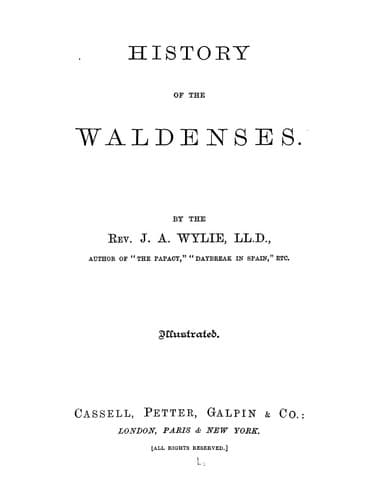
History of the WaldensesWylie, J. A. (James Aitken)
History
History of the Waldenses
Wylie, J. A. (James Aitken)
Church history -- Middle Ages, 600-1500; Waldenses
When the storm had abated, Leger assembled the scattered survivors,
in order to take counsel with them as to the steps to be now taken.
It does not surprise us to find that some had begun to entertain the
idea of abandoning the Valleys altogether. Leger strongly dissuaded
them against the thought of forsaking their ancient inheritance. They
must, he said, rebuild their Zion in the faith that the God of their
fathers would not permit the Church of the Valleys to be finally
overthrown. To encourage them, he undertook to lay a representation of
their sufferings and broken condition before their brethren of other
countries, who, he was sure, would hasten to their help at this great
crisis. These counsels prevailed. “Our tears are no longer of water,”
so wrote the remnant of the slaughtered Vaudois to the Protestants of
Europe, “they are of blood; they do not merely obscure our sight, they
choke our very hearts. Our hands tremble and our heads ache by the
many blows we have received. We cannot frame an epistle answerable
to the intent of our minds, and the strangeness of our desolations.
We pray you to excuse us, and to collect amid our groans the meaning
of what we fain would utter.” After this touching introduction, they
proceeded with a representation of their state, expressing themselves
in terms the moderation of which contrasts strongly with the extent of
their wrongs. Protestant Europe was horror-struck when it heard of the
massacre.
Nowhere did these awful tidings awaken a deeper sympathy or kindle a
stronger indignation than in England. Cromwell, who was then at the
head of the State, proclaimed a fast, ordered a collection for the
sufferers,[122] and wrote to all the Protestant princes, and to the
King of France, with the intent of enlisting their sympathy and aid
in behalf of the Vaudois. One of the noblest as well as most sacred
of the tasks ever undertaken by the great poet, who then acted as the
Protector’s Latin secretary, was the writing of these letters. Milton’s
pen was not less gloriously occupied when writing in behalf of these
venerable sufferers for conscience’ sake, than when writing “Paradise
Lost.” In token of the deep interest he took in this affair, Cromwell
sent Sir Samuel Morland with a letter to the Duke of Savoy, expressive
of the astonishment and sorrow he felt at the barbarities which had
been committed on those who were his brethren in the faith. Cromwell’s
ambassador visited the Valleys on his way to Turin, and saw with his
own eyes the frightful spectacle which the region still presented.
“If,” said he, addressing the duke, the horrors he had just seen giving
point to his eloquence, and kindling his republican plainness into
Puritan fervour, “If the tyrants of all times and ages were alive
again, they would doubtless be ashamed to find that nothing barbarous
nor inhuman, in comparison of these deeds, had ever been invented by
them. In the meantime,” he continued, “the angels are stricken with
Public-domain text, read in full here on John Shaqi.
Reviews
Reviews
No reviews yet
Be the first to share your thoughts on this work.
Elsewhere in the archive
Join the Discussion
Join the discussion
Sign in to leave a comment or review.
Sign InorCreate an account