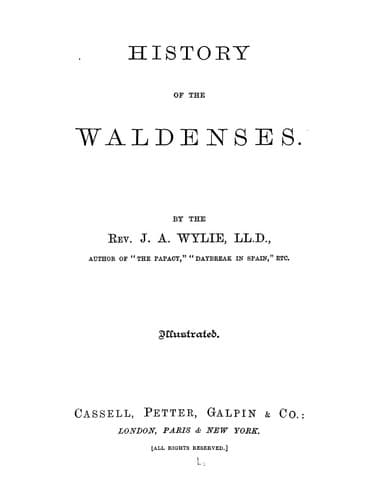
History of the WaldensesWylie, J. A. (James Aitken)
History
History of the Waldenses
Wylie, J. A. (James Aitken)
Church history -- Middle Ages, 600-1500; Waldenses
horror; men are dizzy with amazement; heaven itself appears astonished
with the cries of the dying, and the very earth to blush with the gore
of so many innocent persons. Avenge not thyself, O God, for this mighty
wickedness, this parricidal slaughter! Let thy blood, O Christ, wash
out this blood!”[123]
We have repeatedly mentioned the Castelluzzo in our narrative of this
people and their many martyrdoms. It is closely connected with the
Massacre of 1655, and as such kindled the muse of Milton. It stands at
the entrance of the Valleys, its feet swathed in feathery woods; above
which is a mass of _débris_ and fallen rocks, which countless tempests
have gathered like a girdle round its middle. From amidst these the
supreme column shoots up, pillar-like, and touches that white cloud
which is floating past in mid-heaven. One can see a dark spot on the
face of the cliff just below the crowning rocks of the summit. It would
be taken for the shadow of a passing cloud upon the mountain, were it
not that it is immovable. That is the mouth of a cave so roomy, it is
said, as to be able to contain some hundreds. To this friendly chamber
the Waldenses were wont to flee when the valley beneath was a perfect
Pandemonium, glittering with steel, red with crime, and ringing with
execrations and blasphemies. To this cave many of the Vaudois fled on
occasion of the great massacre. But, alas! thither the persecutor
tracked them, and dragging them forth rolled them down the awful
precipice.
The law that indissolubly links great crimes with the spot where they
were perpetrated, has written the Massacre of 1655 on this mountain,
and given it in eternal keeping to its rock. There is not another such
martyrs’ monument in the whole world. While the Castelluzzo stands the
memory of this great crime cannot die; through all the ages it will
continue to cry, and that cry our sublimest poet has interpreted in his
sublime sonnet:--
“Avenge, O Lord, Thy slaughtered saints, whose bones
Lie scattered on the Alpine mountains cold;
Even them who kept Thy truth so pure of old,
When all our fathers worshipt stocks and stones,
Forget not: in Thy book record their groans
Who were Thy sheep, and in their ancient fold
Slain by the bloody Piedmontese, that roll’d
Mother with infant down the rocks. Their moans
The vales redoubled to the hills, and they
To heaven. Their martyr’d blood and ashes sow
O’er all the Italian fields, where still doth sway
The triple tyrant; that from these may grow
A hundredfold, who having learned Thy way,
Early may fly the Babylonian woe.”
CHAPTER XIV.
EXPLOITS OF GIANAVELLO--MASSACRE AND PILLAGE OF RORA.
Public-domain text, read in full here on John Shaqi.
Reviews
Reviews
No reviews yet
Be the first to share your thoughts on this work.
Elsewhere in the archive
Join the Discussion
Join the discussion
Sign in to leave a comment or review.
Sign InorCreate an account