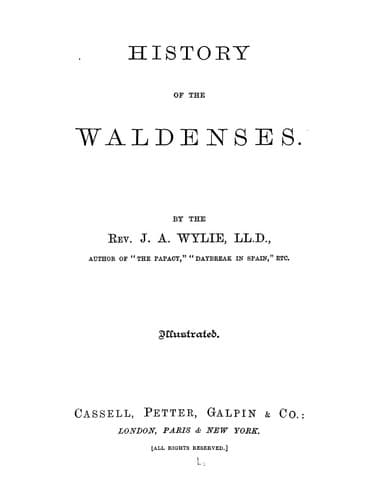
History of the WaldensesWylie, J. A. (James Aitken)
History
History of the Waldenses
Wylie, J. A. (James Aitken)
Church history -- Middle Ages, 600-1500; Waldenses
Seeing this mighty host before their Valleys, the Waldenses sent two
of their patriarchs to request an interview with Cataneo, and turn,
if possible, his heart to peace. John Campo and John Desiderio were
dispatched on this embassy. “Do not condemn us without hearing us,”
said they, “for we are Christians and faithful subjects; and our Barbes
are prepared to prove, in public or in private, that our doctrines are
conformable to the Word of God.... Our hope in God is greater than our
desire to please men; beware how you draw down upon yourselves His
anger by persecuting us; for remember that, if God so wills it, all the
forces you have assembled against us will nothing avail.”
These were weighty words, and they were meekly spoken, but as to
changing Cataneo’s purpose, or softening the hearts of the ruffian-host
which he led, they might as well have been addressed to the rocks which
rose around the speakers. Nevertheless, they fell not to the ground.
Cataneo, believing that the Vaudois herdsmen would not stand an hour
before his men-at-arms, and desirous of striking a finishing blow,
divided his army into a number of attacking parties, which were
to begin the battle on various points at the same time. The folly
of extending his line so as to embrace the whole territory led to
Cataneo’s destruction; but his strategy was rewarded with a few small
successes at first.
One troop was stationed at the entrance of the Val Lucerna; we shall
follow its march till it disappears on the mountains which it hopes
to conquer, and then we shall return and narrate the more decisive
operations of the campaign under Cataneo in the Val Angrogna.
The first step of the invaders was to occupy the town of La Torre,
situated on the angle formed by the junction of the Val Lucerna and
the Val Angrogna, the silver Pelice at its feet and the shadow of
the Castelluzzo covering it. The soldiers were probably spared the
necessity or denied the pleasure of slaughter, the inhabitants having
fled to the mountains. The valley beyond La Torre is too open to admit
of being defended, and the troop advanced along it unopposed. Than this
theatre of war nothing in ordinary times is more peaceful, nothing
more grand. A carpet of rich meadows clothes it from side to side;
fruitful trees fleck it with their shadows; the Pelice waters it; and
on either hand is a wall of mountains, whose sides display successive
zones of festooned vines, golden grain, dark chestnut forests, and rich
pasturages. Over these are hung stupendous battlements of rock; and
above all, towering high in air, are the everlasting peaks in their
robes of ice and snow. But the sublimities of nature were nothing to
men whose thoughts were only of blood.
Public-domain text, read in full here on John Shaqi.
Reviews
Reviews
No reviews yet
Be the first to share your thoughts on this work.
Join the Discussion
Join the discussion
Sign in to leave a comment or review.
Sign InorCreate an account