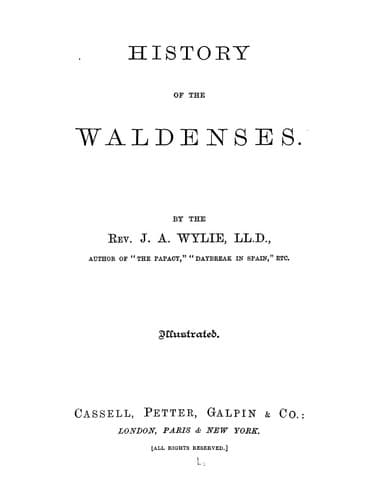
History of the WaldensesWylie, J. A. (James Aitken)
History
History of the Waldenses
Wylie, J. A. (James Aitken)
Church history -- Middle Ages, 600-1500; Waldenses
In July and August the heat was excessive, and the malady raged yet
more furiously. In the month of July four of the pastors were carried
off by the plague; in August seven others died; and in the following
month another, the twelfth, was mortally stricken. There remained now
only three pastors, and it was remarked that they belonged to three
several valleys--Lucerna, Martino, and Perosa. The three survivors
met on the heights of Angrogna, to consult with the deputies of the
various parishes regarding the means of providing for the celebration
of worship. They wrote to Geneva and Dauphiné requesting that pastors
might be sent to supply the place of those whom the plague had struck
down, that so the venerable Church of the Valleys, which had survived
so many calamities, might not become extinct. They also recalled
Antoine Leger from Constantinople.[101]
The plague subsided during the winter, but in spring (1631) it rose
up again in renewed force. Of the three surviving pastors, one other
died; leaving thus only two, Pierre Gilles of Lucerna, and Valerius
Gross of Martino. With the heats of the summer the pestilence waxed in
strength. Armies, going and coming in the Valleys, suffered equally
with the inhabitants. Horsemen would be seen to drop from the saddle on
the highway, seized with sudden illness. Soldiers and sutlers, struck
in by-paths, lay there infecting the air with their corpses. In La
Torre alone fifty families became extinct. The most moderate estimate
of the numbers cut off by the plague is 10,000, or from a half to
two-thirds of the entire population of the Valleys. The corn in many
places remained uncut, the grapes rotted on the bough, and the fruit
dropped from the tree. Strangers who had come to find health in the
pure mountain air obtained from the soil nothing but a grave. Towns
and villages, which had rung so recently from the sounds of industry,
were now silent. Parents were without children, and children were
without parents. Patriarchs, who had been wont with pride and joy to
gather round them their numerous grandchildren, had seen them sicken
and die, and were now alone. The venerable pastor Gilles lost his four
elder sons. Though continually present in the homes of the stricken,
and at the bedsides of the dying, he himself was spared to compile the
monuments of his ancient Church, and narrate among other woes that
which had just passed over his native land, and “part of which he had
been.”
Public-domain text, read in full here on John Shaqi.
Reviews
Reviews
No reviews yet
Be the first to share your thoughts on this work.
Elsewhere in the archive
Join the Discussion
Join the discussion
Sign in to leave a comment or review.
Sign InorCreate an account