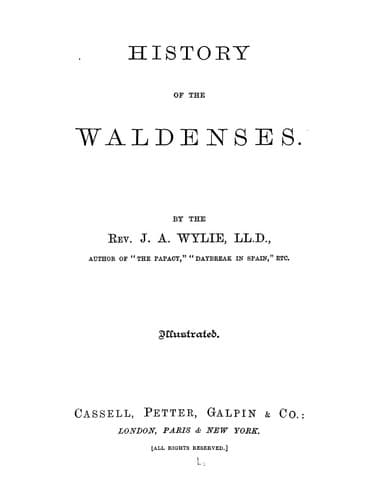
History of the WaldensesWylie, J. A. (James Aitken)
History
History of the Waldenses
Wylie, J. A. (James Aitken)
Church history -- Middle Ages, 600-1500; Waldenses
souls that sold themselves for bread, regular collections were made
in the chapels, and in private families, in the shops, in the inns,
in the gambling-houses, in the streets--everywhere was alms-begging
in operation. The Marchioness of Pianeza herself, great lady as she
was, used every second or third day to make a circuit in search of
subscriptions, even going into the taverns for that purpose.... If
any person of condition, who was believed able to contribute a coin,
chanced to arrive at any hotel in town, these ladies did not fail to
wait upon him, purse in hand, and solicit a donation. When persons of
substance known to belong to the religion [Reformed] arrived in Turin,
they did not scruple to ask money of them for the propagation of the
faith, and the influence of the marchioness, or fear of losing their
errand and ruining their affairs, would often induce such to comply.”
While busied in the prosecution of these schemes the Marchioness de
Pianeza was stricken with death. Feeling remorse, and wishing to make
atonement, she summoned her lord, from whom she had been parted many
years, to her bedside, and charged him, as he valued the repose of her
soul and the safety of his own, to continue the good work, on which her
heart had been so much set, of converting the Vaudois. To stimulate his
zeal, she bequeathed him a sum of money, which, however, he could not
touch till he had fulfilled the condition on which it was granted. The
marquis undertook the task with the utmost goodwill.[106] A bigot and a
soldier, he could think of only one way of converting the Vaudois. It
was now that the storm burst.
On the 25th of January, 1655, came the famous order of Gastaldo. This
decree commanded all the Vaudois families domiciled in the communes of
Lucerna, Fenile, Bubiana, Bricherasio, San Giovanni, and La Torre--in
short, the whole of that rich district that separates their capital
from the plain of Piedmont--to quit their dwellings within three days,
and retire into the Valleys of Bobbio, Angrogna, and Rora. This they
were to do on pain of death. They were further required to sell their
lands to Romanists within twenty days. Those who were willing to abjure
the Protestant faith were exempted from the decree.
Public-domain text, read in full here on John Shaqi.
Reviews
Reviews
No reviews yet
Be the first to share your thoughts on this work.
Elsewhere in the archive
Join the Discussion
Join the discussion
Sign in to leave a comment or review.
Sign InorCreate an account