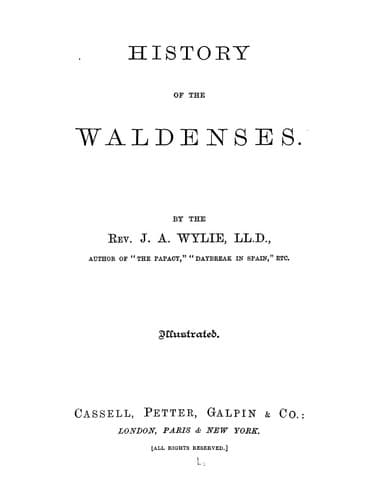
History of the WaldensesWylie, J. A. (James Aitken)
History
History of the Waldenses
Wylie, J. A. (James Aitken)
Church history -- Middle Ages, 600-1500; Waldenses
Anything more inhuman and barbarous under the circumstances than this
edict it would not be easy to imagine. It was the depth of winter,
and an Alpine winter has terrors unknown to the winters of even more
northern regions. How ever could a population like that on which
the decree fell, including young children and old men, the sick and
bed-ridden, the blind and the lame, undertake a journey across swollen
rivers, through valleys buried in snow, and over mountains covered with
ice? They must inevitably perish, and the edict that cast them out was
but another form of condemning them to die of cold and hunger. “Pray
ye,” said Christ, when warning his disciples to flee when they should
see the Roman armies gathering round Jerusalem, “pray ye that your
flight be not in the winter.” The Romish Propaganda at Turin chose this
season for the enforced flight of the Vaudois. Cold were the icy peaks
that looked down on this miserable troop, who were now fording the
torrents and now struggling up the mountain tracks; but the heart of
the persecutor was colder still. True, an alternative was offered them;
they might go to mass. Did they avail themselves of it? The historian
Leger informs us that he had a congregation of wellnigh 2,000 persons,
and that not a man of them all accepted the alternative. “I can well
bear them this testimony,” he observes, “seeing I was their pastor for
eleven years, and I knew every one of them by name; judge, reader,
whether I had not cause to weep for joy, as well as for sorrow, when I
saw that all the fury of these wolves was not able to influence one of
these lambs, and that no earthly advantage could shake their constancy.
And when I marked the traces of their blood on the snow and ice over
which they had dragged their lacerated limbs, had I not cause to bless
God that I had seen accomplished in their poor bodies what remained of
the measure of the sufferings of Christ, and especially when I beheld
this heavy cross borne by them with a fortitude so noble?”[107]
The Vaudois of the other valleys welcomed these poor exiles, and
joyfully shared with them their own humble and scanty fare. They spread
the table for all, and loaded it with polenta and roasted chestnuts,
with the milk and butter of their mountains, to which they did not
forget to add a cup of that red wine which their valleys produce.[108]
Their enemies were amazed when they saw the whole community rise up as
one man and depart.
Public-domain text, read in full here on John Shaqi.
Reviews
Reviews
No reviews yet
Be the first to share your thoughts on this work.
Elsewhere in the archive
Join the Discussion
Join the discussion
Sign in to leave a comment or review.
Sign InorCreate an account