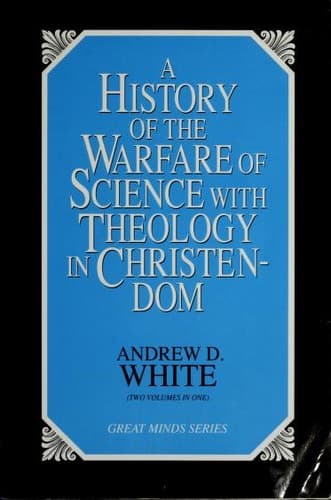
History of the Warfare of Science with Theology in ChristendomWhite, Andrew Dickson
Religion
History of the Warfare of Science with Theology in Christendom
White, Andrew Dickson
Religion and science -- History
VI. The Retreat of the Church after its Victory over Galileo.
The easy path for the Protestant theologians
The difficulties of the older Church.--The papal infallibility
fully committed against the Copernican theory
Attempts at evasion--first plea: that Galileo was condemned not
for affirming the earth's motion, but for supporting it from
Scripture
Its easy refutation
Second plea: that he was condemned not for heresy, but for
contumacy
Folly of this assertion
Third plea: that it was all a quarrel between Aristotelian
professors and those favouring the experimental method
Fourth plea: that the condemnation of Galileo was "provisory"
Fifth plea: that he was no more a victim of Catholics than of
Protestants
Efforts to blacken Galileo's character
Efforts to suppress the documents of his trial
Their fruitlessness
Sixth plea: that the popes as popes had never condemned his
theory
Its confutation from their own mouths
Abandonment of the contention by honest Catholics
Two efforts at compromise--Newman, De Bonald
Effect of all this on thinking men
The fault not in Catholicism more than in Protestantism--not in
religion, but in theology
CHAPTER IV.
FROM "SIGNS AND WONDERS" TO LAW IN THE HEAVENS.
I. The Theological View.
Early beliefs as to comets, meteors, and eclipses
Their inheritance by Jews and Christians
The belief regarding comets especially harmful as a source of
superstitious terror
Its transmission through the Middle Ages
Its culmination under Pope Calixtus III
Beginnings of scepticism--Copernicus, Paracelsus, Scaliger
Firmness of theologians, Catholic and Protestant, in its support
II. Theological Efforts to crush the Scientific View.
The effort through the universities.--The effort through the
pulpits
Heerbrand at Tubingen and Dieterich at Marburg
Maestlin at Heidelberg
Buttner, Vossius, Torreblanca, Fromundus
Father Augustin de Angelis at Rome
Reinzer at Linz
Celichius at Magdeburg
Conrad Dieterich's sermon at Ulm
Erni and others in Switzerland
Comet doggerel
Echoes from New England--Danforth, Morton, Increase Mather
III. The Invasion of Scepticism.
Rationalism of Cotton Mather, and its cause
Blaise de Vigenere
Erastus
Bekker, Lubienitzky, Pierre Petit
Bayle
Fontenelle
The scientific movement beneath all this
IV. Theological Efforts at Compromise.--The Final Victory of
Science.
The admission that some comets are supralunar
Difference between scientific and theological reasoning
Development of the reasoning of Tycho and Kepler--Cassini, Hevel,
Doerfel, Bernouilli, Newton
Completion of the victory by Halley and Clairaut
Survivals of the superstition--Joseph de Maistre, Forster Arago's
statistics
The theories of Whiston and Burnet, and their influence in
Germany
The superstition ended in America by the lectures of Winthrop
Helpful influence of John Wesley
Effects of the victory
Public-domain text, read in full here on John Shaqi.
Reviews
Reviews
No reviews yet
Be the first to share your thoughts on this work.
Join the Discussion
Join the discussion
Sign in to leave a comment or review.
Sign InorCreate an account