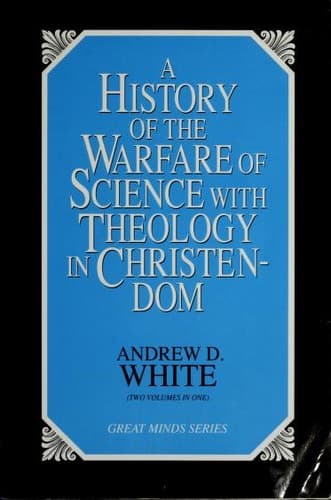
History of the Warfare of Science with Theology in ChristendomWhite, Andrew Dickson
Religion
History of the Warfare of Science with Theology in Christendom
White, Andrew Dickson
Religion and science -- History
(25) For survivals of the early idea, among the Eskimos, of the sky as
supported by mountains, and, among sundry Pacific islanders, of the sky
as a firmament or vault of stone, see Tylor, Early History of Mankind,
second edition, London, 1870, chap. xi; Spencer, Sociology, vol. i, chap
vii, also Andrew Lang, La Mythologie, Paris, 1886, pp. 68-73. For the
Babylonian theories, see George Smith's Chaldean Genesis, and especially
the German translation by Delitzsch, Leipsic, 1876; also, Jensen, Die
Kosmogonien der Babylonier, Strasburg, 1890; see especially in the
appendices, pp. 9 and 10, a drawing representing the whole Babylonian
scheme so closely followed in the Hebrew book Genesis. See also Lukas,
Die Grundbegriffe in den Kosmogonien der alten Volker, Leipsic, 1893,
for a most thorough summing up of the whole subject, with texts showing
the development of Hebrew out of Chaldean and Egyptian conceptions, pp.
44, etc.; also pp. 127 et seq. For the early view in India and
Persia, see citations from the Vedas and the Zend-Avesta in Lethaby,
Architecture, Mysticism, and Myth, chap. i. For the Egyptian view, see
Champollion; also Lenormant, Histoire Ancienne, Maspero, and others. As
to the figures of the heavens upon the ceilings of Egyptian temples,
see Maspero, Archeologie Egyptienne, Paris, 1890; and for engravings of
them, see Lepsius, Denkmaler, vol. i, Bl. 41, and vol. ix, Abth. iv, Bl.
35; also the Description de l'Egypte, published by order of Napoleon,
tome ii, Pl. 14; also Prisse d'Avennes, Art Egyptien, Atlas, tome i, Pl.
35; and especially for a survival at the Temple of Denderah, see Denon,
Voyage en Egypte, Planches 129, 130. For the Egyptian idea of "pillars
of heaven," as alluded to on the stele of victory of Thotmes III,in the
Cairo Museum, see Ebers, Uarda, vol. ii, p. 175, note, Leipsic, 1877. For
a similar Babylonian belief, see Sayce's Herodotus, Appendix, p. 403.
For the belief of Hebrew scriptural writers in a solid "firmament,"
see especially Job, xxxviii, 18; also Smith's Bible Dictionary. For
engravings showing the earth and heaven above it as conceived by
Egyptians and Chaldeans, with "pillars of heaven" and "firmament," see
Maspero and Sayce, Dawn of Civilization, London, 1894, pp. 17 and 543.
But, as civilization was developed, there were evolved, especially among
the Greeks, ideas of the earth's sphericity. The Pythagoreans, Plato,
and Aristotle especially cherished them. These ideas were vague, they
were mixed with absurdities, but they were germ ideas, and even amid the
luxuriant growth of theology in the early Christian Church these germs
began struggling into life in the minds of a few thinking men, and these
men renewed the suggestion that the earth is a globe.(26)
Public-domain text, read in full here on John Shaqi.
Reviews
Reviews
No reviews yet
Be the first to share your thoughts on this work.
Elsewhere in the archive
Join the Discussion
Join the discussion
Sign in to leave a comment or review.
Sign InorCreate an account