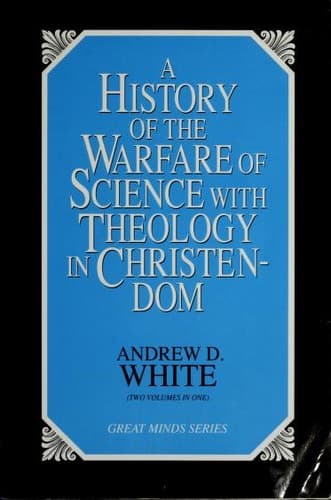
History of the Warfare of Science with Theology in ChristendomWhite, Andrew Dickson
Religion
History of the Warfare of Science with Theology in Christendom
White, Andrew Dickson
Religion and science -- History
(26) The agency of the Pythagoreans in first spreading the doctrine of
the earth's sphericity is generally acknowledged, but the first full and
clear utterance of it to the world was by Aristotle. Very fruitful, too,
was the statement of the new theory given by Plato in the Timaeus; see
Jowett's translation, 62, c. Also the Phaedo, pp.449 et seq. See also
Grote on Plato's doctrine on the sphericity of the earth; also Sir G. C.
Lewis's Astronomy of the Ancients, London, 1862, chap. iii, section i,
and note. Cicero's mention of the antipodes, and his reference to the
passage in the Timaeus, are even more remarkable than the latter, in
that they much more clearly foreshadow the modern doctrine. See his
Academic Questions, ii; also Tusc. Quest., i and v, 24. For a very full
summary of the views of the ancients on the sphericity of the earth,
see Kretschmer, Die physische Erkunde im christlichen Mittelalter,
Wien, 1889, pp. 35 et seq.; also Eiken, Geschichte der mittelalterlichen
Weltanschauung, Stuttgart, 1887, Dritter Theil, chap. vi. For citations
and summaries, see Whewell, Hist. Induct. Sciences, vol. i, p. 189, and
St. Martin, Hist. de la Geog., Paris, 1873, p. 96; also Leopardi, Saggio
sopra gli errori popolari degli antichi, Firenze, 1851, chap. xii, pp.
184 et seq.
A few of the larger-minded fathers of the Church, influenced possibly
by Pythagorean traditions, but certainly by Aristotle and Plato, were
willing to accept this view, but the majority of them took fright at
once. To them it seemed fraught with dangers to Scripture, by which, of
course, they meant their interpretation of Scripture. Among the first
who took up arms against it was Eusebius. In view of the New Testament
texts indicating the immediately approaching, end of the world, he
endeavoured to turn off this idea by bringing scientific studies
into contempt. Speaking of investigators, he said, "It is not through
ignorance of the things admired by them, but through contempt of their
useless labour, that we think little of these matters, turning our
souls to better things." Basil of Caesarea declared it "a matter of no
interest to us whether the earth is a sphere or a cylinder or a disk, or
concave in the middle like a fan." Lactantius referred to the ideas
of those studying astronomy as "bad and senseless," and opposed the
doctrine of the earth's sphericity both from Scripture and reason.
St. John Chrysostom also exerted his influence against this scientific
belief; and Ephraem Syrus, the greatest man of the old Syrian Church,
widely known as the "lute of the Holy Ghost," opposed it no less
earnestly.
Public-domain text, read in full here on John Shaqi.
Reviews
Reviews
No reviews yet
Be the first to share your thoughts on this work.
Elsewhere in the archive
Join the Discussion
Join the discussion
Sign in to leave a comment or review.
Sign InorCreate an account