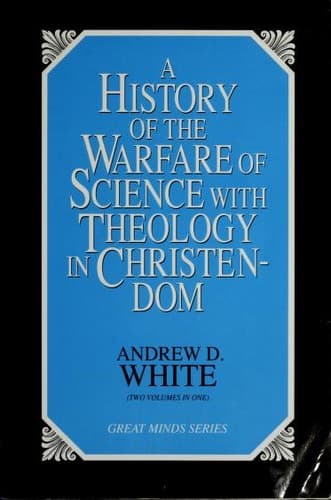
History of the Warfare of Science with Theology in ChristendomWhite, Andrew Dickson
Religion
History of the Warfare of Science with Theology in Christendom
White, Andrew Dickson
Religion and science -- History
To all of them this idea seemed dangerous; to most of them it seemed
damnable. St. Basil and St. Ambrose were tolerant enough to allow that
a man might be saved who thought the earth inhabited on its opposite
sides; but the great majority of the fathers doubted the possibility of
salvation to such misbelievers. The great champion of the orthodox view
was St. Augustine. Though he seemed inclined to yield a little in regard
to the sphericity of the earth, he fought the idea that men exist on the
other side of it, saying that "Scripture speaks of no such descendants
of Adam," he insists that men could not be allowed by the Almighty to
live there, since if they did they could not see Christ at His second
coming descending through the air. But his most cogent appeal, one which
we find echoed from theologian to theologian during a thousand years
afterward, is to the nineteenth Psalm, and to its confirmation in the
Epistle to the Romans; to the words, "Their line is gone out through
all the earth, and their words to the end of the world." He dwells with
great force on the fact that St. Paul based one of his most powerful
arguments upon this declaration regarding the preachers of the gospel,
and that he declared even more explicitly that "Verily, their sound
went into all the earth, and their words unto the ends of the world."
Thenceforth we find it constantly declared that, as those preachers
did not go to the antipodes, no antipodes can exist; and hence that the
supporters of this geographical doctrine "give the lie direct to King
David and to St. Paul, and therefore to the Holy Ghost." Thus the great
Bishop of Hippo taught the whole world for over a thousand years that,
as there was no preaching of the gospel on the opposite side of the
earth, there could be no human beings there.
The great authority of Augustine, and the cogency of his scriptural
argument, held the Church firmly against the doctrine of the antipodes;
all schools of interpretation were now agreed--the followers of the
allegorical tendencies of Alexandria, the strictly literal exegetes of
Syria, the more eclectic theologians of the West. For over a thousand
years it was held in the Church, "always, everywhere, and by all," that
there could not be human beings on the opposite sides of the earth, even
if the earth had opposite sides; and, when attacked by gainsayers, the
great mass of true believers, from the fourth century to the fifteenth,
simply used that opiate which had so soothing an effect on John Henry
Newman in the nineteenth century--securus judicat orbis terrarum.
Public-domain text, read in full here on John Shaqi.
Reviews
Reviews
No reviews yet
Be the first to share your thoughts on this work.
Elsewhere in the archive
Join the Discussion
Join the discussion
Sign in to leave a comment or review.
Sign InorCreate an account