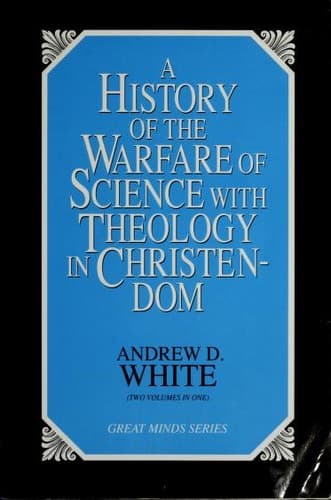
History of the Warfare of Science with Theology in ChristendomWhite, Andrew Dickson
Religion
History of the Warfare of Science with Theology in Christendom
White, Andrew Dickson
Religion and science -- History
Yet gainsayers still appeared. That the doctrine of the antipodes
continued to have life, is shown by the fact that in the sixth century
Procopius of Gaza attacks it with a tremendous argument. He declares
that, if there be men on the other side of the earth, Christ must have
gone there and suffered a second time to save them; and, therefore, that
there must have been there, as necessary preliminaries to his coming, a
duplicate Eden, Adam, serpent, and deluge.
Cosmas Indicopleustes also attacked the doctrine with especial
bitterness, citing a passage from St. Luke to prove that antipodes are
theologically impossible.
At the end of the sixth century came a man from whom much might be
expected--St. Isidore of Seville. He had pondered over ancient thought
in science, and, as we have seen, had dared proclaim his belief in the
sphericity of the earth; but with that he stopped. As to the antipodes,
the authority of the Psalmist, St. Paul, and St. Augustine silences him;
he shuns the whole question as unlawful, subjects reason to faith, and
declares that men can not and ought not to exist on opposite sides of
the earth.(33)
(33)For the opinions of Basil, Ambrose, and others, see Lecky, History
of Rationalism in Europe, New York, 1872, vol. i, p. 279. Also Letronne,
in Revue des Deux Mondes, March, 1834. For Lactantius, see citations
already given. For St. Augustine's opinion, see the De Civitate Dei,
xvi, 9, where this great father of the church shows that the antipodes
"nulla ratione credendum est." For the unanimity of the fathers against
the antipodes, see Zockler, vol. 1, p. 127. For a very naive summary,
see Joseph Acosta, Natural and Moral History of the Indies, Grimston's
translation, republished by the Hakluyt Soc., chaps. vii and viii; also
citations in Buckle's Posthumous Works, vol. ii, p. 645. For Procopius
of Gaza, see Kretschmer, p. 55. See also, on the general subject,
Peschel, Geschichte der Erdkunde, pp. 96-97. For Isidore, see citations
already given. To understand the embarrassment caused by these
utterances of the fathers to scientific men of a later period, see
letter of Agricola to Joachim Vadianus in 1514. Agricola asks Vadianus
to give his views regarding the antipodes, saying that he himself does
not know what to do, between the fathers on the one side and the
learned men of modern times on the other. On the other hand, for the
embarrassment caused to the Church by this mistaken zeal of the
fathers, see Kepler's references and Fromund's replies; also De Morgan,
Paradoxes, p. 58. Kepler appears to have taken great delight in throwing
the views of Lactantius into the teeth of his adversaries.
Under such pressure this scientific truth seems to have disappeared for
nearly two hundred years; but by the eighth century the sphericity
of the earth had come to be generally accepted among the leaders of
thought, and now the doctrine of the antipodes was again asserted by a
bishop, Virgil of Salzburg.
Public-domain text, read in full here on John Shaqi.
Reviews
Reviews
No reviews yet
Be the first to share your thoughts on this work.
Elsewhere in the archive
Join the Discussion
Join the discussion
Sign in to leave a comment or review.
Sign InorCreate an account