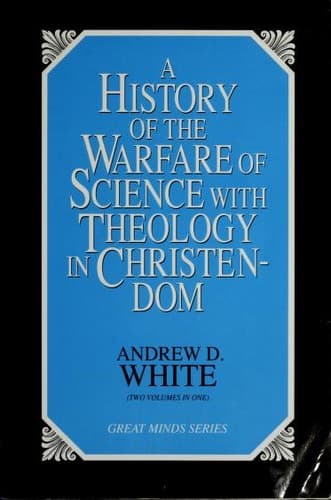
History of the Warfare of Science with Theology in ChristendomWhite, Andrew Dickson
Religion
History of the Warfare of Science with Theology in Christendom
White, Andrew Dickson
Religion and science -- History
(38) For Servetus's geographical offense, see Rilliet, Relation du
Proces criminel contre Michel Servet d'apres les Documents originaux,
Geneva, 1844, pp. 42,43; also Willis, Servetus and Calvin, London, 1877,
p. 325. The passage condemned is in the Ptolemy of 1535, fol. 41. It was
discreetly retrenched in a reprint of the same edition.
In summing up the action of the Church upon geography, we must say,
then, that the dogmas developed in strict adherence to Scripture and
the conceptions held in the Church during many centuries "always, every
where, and by all," were, on the whole, steadily hostile to truth; but
it is only just to make a distinction here between the religious and the
theological spirit. To the religious spirit are largely due several
of the noblest among the great voyages of discovery. A deep longing to
extend the realms of Christianity influenced the minds of Prince John
of Portugal, in his great series of efforts along the African coast;
of Vasco da Gama, in his circumnavigation of the Cape of Good Hope; of
Magellan, in his voyage around the world; and doubtless found a place
among the more worldly motives of Columbus.(39)
(39) As to the earlier mixture in the motives of Columbus, it may be
well to compare with the earlier biographies the recent ones by Dr.
Winsor and President Adams.
Thus, in this field, from the supremacy accorded to theology, we find
resulting that tendency to dogmatism which has shown itself in all
ages the deadly foe not only of scientific inquiry but of the higher
religious spirit itself, while from the love of truth for truth's sake,
which has been the inspiration of all fruitful work in science, nothing
but advantage has ever resulted to religion.
CHAPTER III. ASTRONOMY.
I. THE OLD SACRED THEORY OF THE UNIVERSE.
The next great series of battles was fought over the relations of the
visible heavens to the earth.
In the early Church, in view of the doctrine so prominent in the New
Testament, that the earth was soon to be destroyed, and that there were
to be "new heavens and a new earth," astronomy, like other branches of
science, was generally looked upon as futile. Why study the old heavens
and the old earth, when they were so soon to be replaced with something
infinitely better? This feeling appears in St. Augustine's famous
utterance, "What concern is it to me whether the heavens as a sphere
inclose the earth in the middle of the world or overhang it on either
side?"
As to the heavenly bodies, theologians looked on them as at best only
objects of pious speculation. Regarding their nature the fathers of the
Church were divided. Origen, and others with him, thought them living
beings possessed of souls, and this belief was mainly based upon the
scriptural vision of the morning stars. singing together, and upon
the beautiful appeal to the "stars and light" in the song of the three
children--the Benedicite--which the Anglican communion has so wisely
retained in its Liturgy.
Public-domain text, read in full here on John Shaqi.
Reviews
Reviews
No reviews yet
Be the first to share your thoughts on this work.
Elsewhere in the archive
Join the Discussion
Join the discussion
Sign in to leave a comment or review.
Sign InorCreate an account