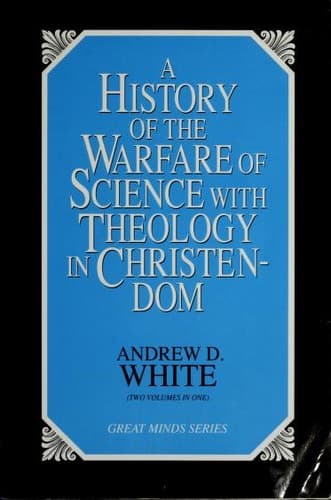
History of the Warfare of Science with Theology in ChristendomWhite, Andrew Dickson
Religion
History of the Warfare of Science with Theology in Christendom
White, Andrew Dickson
Religion and science -- History
Other fathers thought the stars abiding-places of the angels, and that
stars were moved by angels. The Gnostics thought the stars spiritual
beings governed by angels, and appointed not to cause earthly events but
to indicate them.
As to the heavens in general, the prevailing view in the Church
was based upon the scriptural declarations that a solid vault--a
"firmament"--was extended above the earth, and that the heavenly
bodies were simply lights hung within it. This was for a time held
very tenaciously. St. Philastrius, in his famous treatise on heresies,
pronounced it a heresy to deny that the stars are brought out by God
from his treasure-house and hung in the sky every evening; any other
view he declared "false to the Catholic faith." This view also survived
in the sacred theory established so firmly by Cosmas in the sixth
century. Having established his plan of the universe upon various texts
in the Old and New Testaments, and having made it a vast oblong box,
covered by the solid "firmament," he brought in additional texts from
Scripture to account for the planetary movements, and developed at
length the theory that the sun and planets are moved and the "windows of
heaven" opened and shut by angels appointed for that purpose.
How intensely real this way of looking at the universe was, we find in
the writings of St. Isidore, the greatest leader of orthodox thought
in the seventh century. He affirms that since the fall of man, and
on account of it, the sun and moon shine with a feebler light; but he
proves from a text in Isaiah that when the world shall be fully redeemed
these "great lights" will shine again in all their early splendour.
But, despite these authorities and their theological finalities, the
evolution of scientific thought continued, its main germ being the
geocentric doctrine--the doctrine that the earth is the centre, and that
the sun and planets revolve about it.(40)
(40) For passage cited from Clement of Alexandria, see English
translation, Edinburgh, 1869, vol. ii, p. 368; also the Miscellanies,
Book V, cap. vi. For typical statements by St. Augustine, see De Genesi,
ii, cap. ix, in Migne, Patr. Lat., tome xxiv, pp. 270-271. For Origen's
view, see the De Principiis, lib. i, cap. vii; see also Leopardi's
Errori Populari, cap. xi; also Wilson's Selections from the Prophetic
Scriptures in Ante-Nicene Library, p. 132. For Philo Judaeus, see On the
Creation of the World, chaps. xviii and xix, and On Monarchy, chap. i.
For St. Isidore, see the De Ordine Creaturarum, cap v, in Migne, Patr.
Lat., lxxxiii, pp. 923-925; also 1000, 1001. For Philastrius, see the
De Hoeresibus, chap. cxxxiii, in Migne, tome xii, p. 1264. For Cosmas's
view, see his Topographia Christiana, in Montfaucon, Col. Nov. Patrum,
ii, p. 150, and elsewhere as cited in my chapter on Geography.
Public-domain text, read in full here on John Shaqi.
Reviews
Reviews
No reviews yet
Be the first to share your thoughts on this work.
Elsewhere in the archive
Join the Discussion
Join the discussion
Sign in to leave a comment or review.
Sign InorCreate an account