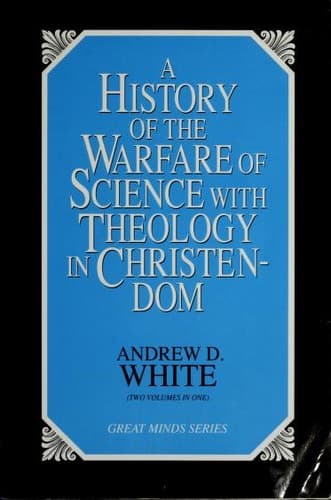
History of the Warfare of Science with Theology in ChristendomWhite, Andrew Dickson
Religion
History of the Warfare of Science with Theology in Christendom
White, Andrew Dickson
Religion and science -- History
This doctrine was of the highest respectability: it had been developed
at a very early period, and had been elaborated until it accounted
well for the apparent movements of the heavenly bodies; its final name,
"Ptolemaic theory," carried weight; and, having thus come from antiquity
into the Christian world, St. Clement of Alexandria demonstrated that
the altar in the Jewish tabernacle was "a symbol of the earth placed
in the middle of the universe": nothing more was needed; the geocentric
theory was fully adopted by the Church and universally held to agree
with the letter and spirit of Scripture.(41)
(41) As to the respectibility of the geocentric theory, etc., see
Grote's Plato, vol. iii, p. 257; also Sir G. C. Lewis's Astronomy of the
Ancients, chap. iii, sec. 1, for a very thoughtful statement of Plato's
view, and differing from ancient statements. For plausible elaboration
of it, and for supposed agreement of the Scripture with it, see
Fromundus, Anti-Aristarchus, Antwerp, 1631; also Melanchthon's Initia
Doctrinae Physicae. For an admirable statement of the theological view
of the geocentric theory, antipodes, etc., see Eicken, Geschichte und
System der mittelalterlichen Weltanschauung, pp. 618 et seq.
Wrought into this foundation, and based upon it, there was developed
in the Middle Ages, mainly out of fragments of Chaldean and other early
theories preserved in the Hebrew Scriptures, a new sacred system of
astronomy, which became one of the great treasures of the universal
Church--the last word of revelation.
Three great men mainly reared this structure. First was the unknown who
gave to the world the treatises ascribed to Dionysius the Areopagite.
It was unhesitatingly believed that these were the work of St. Paul's
Athenian convert, and therefore virtually of St. Paul himself. Though
now known to be spurious, they were then considered a treasure of
inspiration, and an emperor of the East sent them to an emperor of the
West as the most worthy of gifts. In the ninth century they were widely
circulated in western Europe, and became a fruitful source of thought,
especially on the whole celestial hierarchy. Thus the old ideas of
astronomy were vastly developed, and the heavenly hosts were classed
and named in accordance with indications scattered through the sacred
Scriptures.
The next of these three great theologians was Peter Lombard, professor
at the University of Paris. About the middle of the twelfth century he
gave forth his collection of Sentences, or Statements by the Fathers,
and this remained until the end of the Middle Ages the universal manual
of theology. In it was especially developed the theological view of
man's relation to the universe. The author tells the world: "Just as
man is made for the sake of God--that is, that he may serve Him,--so the
universe is made for the sake of man--that is, that it may serve HIM;
therefore is man placed at the middle point of the universe, that he may
both serve and be served."
Public-domain text, read in full here on John Shaqi.
Reviews
Reviews
No reviews yet
Be the first to share your thoughts on this work.
Elsewhere in the archive
Join the Discussion
Join the discussion
Sign in to leave a comment or review.
Sign InorCreate an account