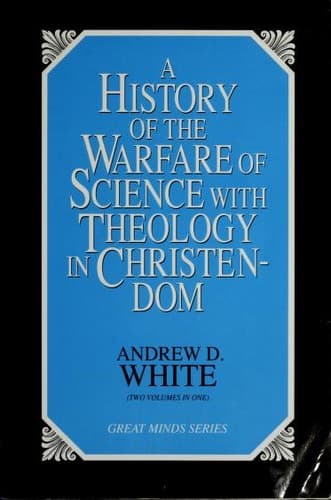
History of the Warfare of Science with Theology in ChristendomWhite, Andrew Dickson
Religion
History of the Warfare of Science with Theology in Christendom
White, Andrew Dickson
Religion and science -- History
As to Copernicus's danger at Rome, the Catholic World for January, 1869,
cites a speech of the Archbishop of Mechlin before the University of
Louvain, to the effect that Copernicus defended his theory at Rome, in
1500, before two thousand scholars; also, that another professor taught
the system in 1528, and was made apostolic notary by Clement VIII. All
this, even if the doctrines taught were identical with Copernicus as
finally developed--which is simply not the case--avails nothing
against the overwhelming testimony that Copernicus felt himself in
danger--testimony which the after-history of the Copernican theory
renders invincible. The very title of Fromundus's book, already cited,
published within a few miles of the archbishop's own cathedral, and
sanctioned expressly by the theological faculty of that same University
of Louvain in 1630, utterly refutes the archbishop's idea that the
Church was inclined to treat Copernicus kindly. The title is as
follows: Ant-Aristarchus sive Orbis-Terrae Immobilis, in quo decretum
S. Congregationis S. R. E. Cardinal. an. M.DC.XVI adversus
Pythagorico-Copernicanos editum defenditur, Antverpiae, MDCXXI.
L'Epinois, Galilee, Paris, 1867, lays stress, p. 14, on the broaching of
the doctrine by De Cusa in 1435, and by Widmanstadt in 1533, and their
kind treatment by Eugenius IV and Clement VII; but this is absolutely
worthless in denying the papal policy afterward. Lange, Geschichte des
Materialismus, vol. i, pp. 217, 218, while admitting that De Cusa
and Widmanstadt sustained this theory and received honors from
their respective popes, shows that, when the Church gave it serious
consideration, it was condemned. There is nothing in this view
unreasonable. It would be a parallel case to that of Leo X, at first
inclined toward Luther and others, in their "squabbles with the envious
friars," and afterward forced to oppose them. That Copernicus felt
the danger, is evident, among other things, by the expression in the
preface: "Statim me explodendum cum tali opinione clamitant." For
dangers at Wittenberg, see Lange, as above, vol. i, p. 217.
But Osiander's courage failed him: he dared not launch the new thought
boldly. He wrote a grovelling preface, endeavouring to excuse Copernicus
for his novel idea, and in this he inserted the apologetic lie that
Copernicus had propounded the doctrine of the earth's movement not as
a fact, but as a hypothesis. He declared that it was lawful for an
astronomer to indulge his imagination, and that this was what Copernicus
had done.
Thus was the greatest and most ennobling, perhaps, of scientific
truths--a truth not less ennobling to religion than to science--forced,
in coming before the world, to sneak and crawl.(46)
Public-domain text, read in full here on John Shaqi.
Reviews
Reviews
No reviews yet
Be the first to share your thoughts on this work.
Elsewhere in the archive
Join the Discussion
Join the discussion
Sign in to leave a comment or review.
Sign InorCreate an account