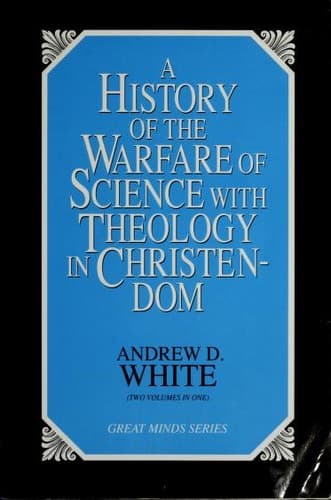
History of the Warfare of Science with Theology in ChristendomWhite, Andrew Dickson
Religion
History of the Warfare of Science with Theology in Christendom
White, Andrew Dickson
Religion and science -- History
(46) Osiander, in a letter to Copernicus, dated April 20, 1541, had
endeavored to reconcile him to such a procedure, and ends by saying,
"Sic enim placidiores reddideris peripatheticos et theologos quos
contradicturos metuis." See Apologia Tychonis in Kepler's Opera Omnia,
Frisch's edition, vol. i, p. 246. Kepler holds Osiander entirely
responsible for this preface. Bertrand, in his Fondateurs de
l'astronomie moderne, gives its text, and thinks it possible that
Copernicus may have yielded "in pure condescension toward his disciple."
But this idea is utterly at variance with expressions in Copernicus's
own dedicatory letter to the Pope, which follows the preface. For a good
summary of the argument, see Figuier, Savants de la Renaissance, pp.
378, 379; see also citation from Gassendi's Life of Copernicus, in
Flammarion, Vie de Copernic, p. 124. Mr. John Fiske, accurate as
he usually is, in his Outlines of Cosmic Philosophy appears to have
followed Laplace, Delambre, and Petit into the error of supposing that
Copernicus, and not Osiander, is responsible for the preface. For the
latest proofs, see Menzer's translation of Copernicus's work, Thorn,
1879, notes on pp. 3 and 4 of the appendix.
On the 24th of May, 1543, the newly printed book arrived at the house of
Copernicus. It was put into his hands; but he was on his deathbed. A few
hours later he was beyond the reach of the conscientious men who would
have blotted his reputation and perhaps have destroyed his life.
Yet not wholly beyond their reach. Even death could not be trusted to
shield him. There seems to have been fear of vengeance upon his corpse,
for on his tombstone was placed no record of his lifelong labours, no
mention of his great discovery; but there was graven upon it simply a
prayer: "I ask not the grace accorded to Paul; not that given to Peter;
give me only the favour which Thou didst show to the thief on the
cross."
Not till thirty years after did a friend dare write on his tombstone a
memorial of his discovery.(47)
(47) See Flammarion, Vie de Copernic, p. 190.
The preface of Osiander, pretending that the book of Copernicus
suggested a hypothesis instead of announcing a truth, served its purpose
well. During nearly seventy years the Church authorities evidently
thought it best not to stir the matter, and in some cases professors
like Calganini were allowed to present the new view purely as a
hypothesis. There were, indeed, mutterings from time to time on the
theological side, but there was no great demonstration against the
system until 1616. Then, when the Copernican doctrine was upheld by
Galileo as a TRUTH, and proved to be a truth by his telescope, the book
was taken in hand by the Roman curia. The statements of Copernicus
were condemned, "until they should be corrected"; and the corrections
required were simply such as would substitute for his conclusions the
old Ptolemaic theory.
Public-domain text, read in full here on John Shaqi.
Reviews
Reviews
No reviews yet
Be the first to share your thoughts on this work.
Elsewhere in the archive
Join the Discussion
Join the discussion
Sign in to leave a comment or review.
Sign InorCreate an account