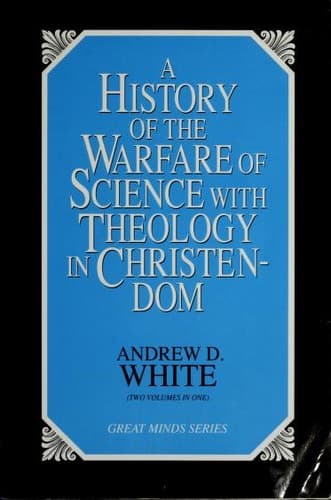
History of the Warfare of Science with Theology in ChristendomWhite, Andrew Dickson
Religion
History of the Warfare of Science with Theology in Christendom
White, Andrew Dickson
Religion and science -- History
That this was their purpose was seen in that year when Galileo was
forbidden to teach or discuss the Copernican theory, and when were
forbidden "all books which affirm the motion of the earth." Henceforth
to read the work of Copernicus was to risk damnation, and the world
accepted the decree.(48) The strongest minds were thus held fast. If
they could not believe the old system, they must PRETEND that they
believed it;--and this, even after the great circumnavigation of the
globe had done so much to open the eyes of the world! Very striking is
the case of the eminent Jesuit missionary Joseph Acosta, whose great
work on the Natural and Moral History of the Indies, published in the
last quarter of the sixteenth century, exploded so many astronomical and
geographical errors. Though at times curiously credulous, he told the
truth as far as he dared; but as to the movement of the heavenly bodies
he remained orthodox--declaring, "I have seen the two poles, whereon the
heavens turn as upon their axletrees."
(48) The authorities deciding this matter in accordance with the wishes
of Pope V and Cardinal Bellarmine were the Congregation of the Index,
or cardinals having charge of the Index Librorum Prohibitorum. Recent
desperate attempts to fasten the responsibility on them as individuals
seem ridiculous in view of the simple fact that their work was
sanctioned by the highest Church authority, and required to be
universally accepted by the Church. Eleven different editions of the
Index in my own possession prove this. Nearly all of these declare on
their title-pages that they are issued by order of the pontiff of the
period, and each is preface by a special papal bull or letter. See
especially the Index of 1664, issued under order of Alexander VII,
and that of 1761, under Benedict XIV. Copernicus's statements were
prohibited in the Index "donec corrigantur." Kepler said that it ought
to be worded "donec explicetur." See Bertand, Fondateurs de l'Astronomie
moderne, p. 57. De Morgan, pp. 57-60, gives the corrections required by
the Index of 1620. Their main aim seems to be to reduce Copernicus
to the grovelling level of Osiander, making his discovery a mere
hypothesis; but occasionally they require a virtual giving up of the
whole Copernican doctrine--e.g., "correction" insisted upon for chap.
viii, p. 6. For a scholarly account of the relation between Prohibitory
and Expurgatory Indexes to each other, see Mendham, Literary Policy
of the Church of Rome; also Reusch, Index der verbotenen Bucher, Bonn,
1855, vol. ii, chaps i and ii. For a brief but very careful statement,
see Gebler, Galileo Galilei, English translation, London, 1879, chap. i;
see also Addis and Arnold's Catholic Dictionary, article Galileo, p.8.
Public-domain text, read in full here on John Shaqi.
Reviews
Reviews
No reviews yet
Be the first to share your thoughts on this work.
Elsewhere in the archive
Join the Discussion
Join the discussion
Sign in to leave a comment or review.
Sign InorCreate an account