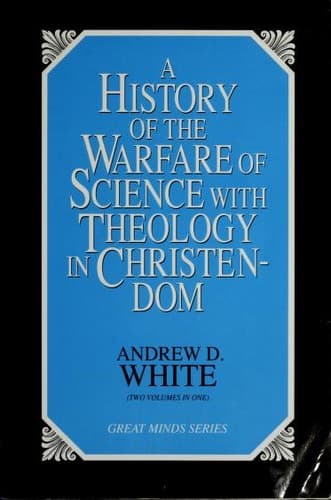
History of the Warfare of Science with Theology in ChristendomWhite, Andrew Dickson
Religion
History of the Warfare of Science with Theology in Christendom
White, Andrew Dickson
Religion and science -- History
(54) For the relation of these discoveries to Copernicus's work, see
Delambre, Histoire de l'Astronomie moderne, discours preliminaire,
p. xiv; also Laplace, Systeme du Monde, vol. i, p. 326; and for more
careful statements, Kepler's Opera Omnia, edit. Frisch, tome ii, p. 464.
For Copernicus's prophecy, see Cantu, Histoire Univerelle, vol. xv, p.
473. (Cantu was an eminent Roman Catholic.)
III. THE WAR UPON GALILEO.
On this new champion, Galileo, the whole war was at last concentrated.
His discoveries had clearly taken the Copernican theory out of the list
of hypotheses, and had placed it before the world as a truth. Against
him, then, the war was long and bitter. The supporters of what was
called "sound learning" declared his discoveries deceptions and his
announcements blasphemy. Semi-scientific professors, endeavouring to
curry favour with the Church, attacked him with sham science;
earnest preachers attacked him with perverted Scripture; theologians,
inquisitors, congregations of cardinals, and at last two popes
dealt with him, and, as was supposed, silenced his impious doctrine
forever.(55)
(55) A very curious example of this sham science employed by theologians
is seen in the argument, frequently used at that time, that, if the
earth really moved, a stone falling from a height would fall back of a
point immediately below its point of starting. This is used by Fromundus
with great effect. It appears never to have occurred to him to test the
matter by dropping a stone from the topmast of a ship. Bezenburg has
mathematically demonstrated just such an aberration in falling bodies,
as is mathematically required by the diurnal motion of the earth. See
Jevons, Principles of Science, pp. 388, 389, second edition, 1877.
I shall present this warfare at some length because, so far as I can
find, no careful summary of it has been given in our language, since the
whole history was placed in a new light by the revelations of the trial
documents in the Vatican Library, honestly published for the first
time by L'Epinois in 1867, and since that by Gebler, Berti, Favaro, and
others.
Public-domain text, read in full here on John Shaqi.
Reviews
Reviews
No reviews yet
Be the first to share your thoughts on this work.
Elsewhere in the archive
Join the Discussion
Join the discussion
Sign in to leave a comment or review.
Sign InorCreate an account