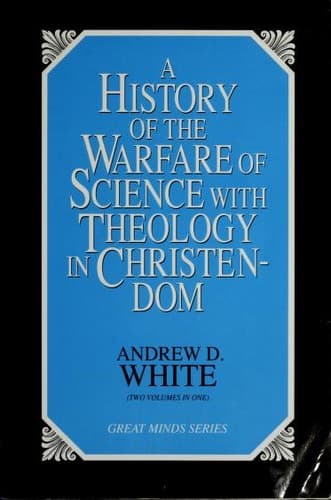
History of the Warfare of Science with Theology in ChristendomWhite, Andrew Dickson
Religion
History of the Warfare of Science with Theology in Christendom
White, Andrew Dickson
Religion and science -- History
The first important attack on Galileo began in 1610, when he announced
that his telescope had revealed the moons of the planet Jupiter. The
enemy saw that this took the Copernican theory out of the realm of
hypothesis, and they gave battle immediately. They denounced both
his method and its results as absurd and impious. As to his method,
professors bred in the "safe science" favoured by the Church argued that
the divinely appointed way of arriving at the truth in astronomy was
by theological reasoning on texts of Scripture; and, as to his
results, they insisted, first, that Aristotle knew nothing of these new
revelations; and, next, that the Bible showed by all applicable types
that there could be only seven planets; that this was proved by the
seven golden candlesticks of the Apocalypse, by the seven-branched
candlestick of the tabernacle, and by the seven churches of Asia; that
from Galileo's doctrine consequences must logically result destructive
to Christian truth. Bishops and priests therefore warned their flocks,
and multitudes of the faithful besought the Inquisition to deal speedily
and sharply with the heretic.(56)
(56) See Delambre on the discovery of the satellites of Jupiter as
the turning-point with the heliocentric doctrine. As to its effects
on Bacon, see Jevons, p. 638, as above. For argument drawn from the
candlestick and the seven churches, see Delambre, p. 20.
In vain did Galileo try to prove the existence of satellites by showing
them to the doubters through his telescope: they either declared it
impious to look, or, if they did look, denounced the satellites as
illusions from the devil. Good Father Clavius declared that "to see
satellites of Jupiter, men had to make an instrument which would
create them." In vain did Galileo try to save the great truths he
had discovered by his letters to the Benedictine Castelli and the
Grand-Duchess Christine, in which he argued that literal biblical
interpretation should not be applied to science; it was answered that
such an argument only made his heresy more detestable; that he was
"worse than Luther or Calvin."
The war on the Copernican theory, which up to that time had been carried
on quietly, now flamed forth. It was declared that the doctrine was
proved false by the standing still of the sun for Joshua, by the
declarations that "the foundations of the earth are fixed so firm that
they can not be moved," and that the sun "runneth about from one end of
the heavens to the other."(57)
Public-domain text, read in full here on John Shaqi.
Reviews
Reviews
No reviews yet
Be the first to share your thoughts on this work.
Elsewhere in the archive
Join the Discussion
Join the discussion
Sign in to leave a comment or review.
Sign InorCreate an account