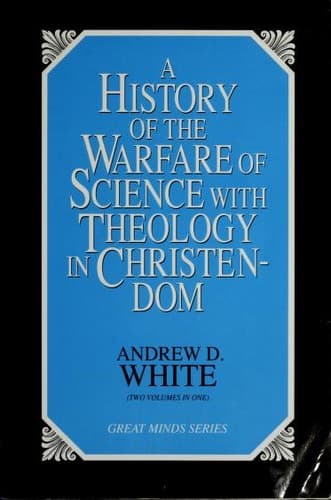
History of the Warfare of Science with Theology in ChristendomWhite, Andrew Dickson
Religion
History of the Warfare of Science with Theology in Christendom
White, Andrew Dickson
Religion and science -- History
(57) For principle points as given, see Libri, Histoire des Sciences
mathematiques en Italie, vol. iv, p. 211; De Morgan, Paradoxes, p. 26,
for account of Father Clavius. It is interesting to know that Clavius,
in his last years, acknowledged that "the whole system of the heavens is
broken down, and must be mended," Cantu, Histoire Universelle, vol.
xv, p. 478. See Th. Martin, Galilee, pp. 34, 208, and 266; also Heller,
Geschichte der Physik, Stuttgart, 1882, vol. i, p. 366. For the original
documents, see L'Epinois, pp.34 and 36; or better, Gebler's careful
edition of the trial (Die Acten des Galileischen Processes, Stuttgart,
1877), pp. 47 et seq. Martin's translation seems somewhat too free. See
also Gebler, Galileo Galilei, English translation, London, 1879, pp.
76-78; also Reusch, Der Process Galilei's und die Jesuiten, Bonn, 1879,
chaps. ix, x, xi.
But the little telescope of Galileo still swept the heavens, and another
revelation was announced--the mountains and valleys in the moon. This
brought on another attack. It was declared that this, and the statement
that the moon shines by light reflected from the sun, directly
contradict the statement in Genesis that the moon is "a great light."
To make the matter worse, a painter, placing the moon in a religious
picture in its usual position beneath the feet of the Blessed Virgin,
outlined on its surface mountains and valleys; this was denounced as a
sacrilege logically resulting from the astronomer's heresy.
Still another struggle was aroused when the hated telescope revealed
spots upon the sun, and their motion indicating the sun's rotation.
Monsignor Elci, head of the University of Pisa, forbade the astronomer
Castelli to mention these spots to his students. Father Busaeus, at the
University of Innspruck, forbade the astronomer Scheiner, who had also
discovered the spots and proposed a SAFE explanation of them, to allow
the new discovery to be known there. At the College of Douay and the
University of Louvain this discovery was expressly placed under the ban,
and this became the general rule among the Catholic universities and
colleges of Europe. The Spanish universities were especially intolerant
of this and similar ideas, and up to a recent period their presentation
was strictly forbidden in the most important university of all--that of
Salamanca.(58)
(58) See Ticknor, History of Spanish Literature, vol. iii.
Public-domain text, read in full here on John Shaqi.
Reviews
Reviews
No reviews yet
Be the first to share your thoughts on this work.
Elsewhere in the archive
Join the Discussion
Join the discussion
Sign in to leave a comment or review.
Sign InorCreate an account