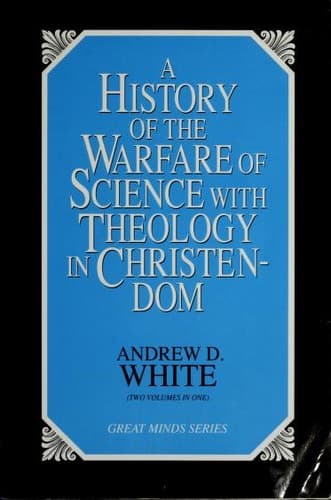
History of the Warfare of Science with Theology in ChristendomWhite, Andrew Dickson
Religion
History of the Warfare of Science with Theology in Christendom
White, Andrew Dickson
Religion and science -- History
The Protestant Church was hardly less energetic against this new
astronomy than the mother Church. The sacred science of the first
Lutheran Reformers was transmitted as a precious legacy, and in the next
century was made much of by Calovius. His great learning and determined
orthodoxy gave him the Lutheran leadership. Utterly refusing to look
at ascertained facts, he cited the turning back of the shadow upon King
Hezekiah's dial and the standing still of the sun for Joshua, denied
the movement of the earth, and denounced the whole new view as clearly
opposed to Scripture. To this day his arguments are repeated by sundry
orthodox leaders of American Lutheranism.
As to the other branches of the Reformed Church, we have already seen
how Calvinists, Anglicans, and, indeed, Protestant sectarians generally,
opposed the new truth.(68)
(68) For Clovius, see Zoeckler, Geschichte, vol. i, pp. 684 and 763. For
Calvin and Turretin, see Shields, The Final Philosophy, pp. 60, 61.
In England, among the strict churchmen, the great Dr. South denounced
the Royal Society as "irreligious," and among the Puritans the eminent
John Owen declared that Newton's discoveries were "built on fallible
phenomena and advanced by many arbitrary presumptions against evident
testimonies of Scripture." Even Milton seems to have hesitated between
the two systems. At the beginning of the eighth book of Paradise Lost
he makes Adam state the difficulties of the Ptolemaic system, and then
brings forward an angel to make the usual orthodox answers. Later,
Milton seems to lean toward the Copernican theory, for, referring to the
earth, he says:
"Or she from west her silent course advance With inoffensive pace, that
spinning sleeps On her soft axle, while she faces even And bears thee
soft with the smooth air along."
English orthodoxy continued to assert itself. In 1724 John Hutchinson,
professor at Cambridge, published his Moses' Principia, a system of
philosophy in which he sought to build up a complete physical system of
the universe from the Bible. In this he assaulted the Newtonian theory
as "atheistic," and led the way for similar attacks by such Church
teachers as Horne, Duncan Forbes, and Jones of Nayland. But one far
greater than these involved himself in this view. That same limitation
of his reason by the simple statements of Scripture which led John
Wesley to declare that, "unless witchcraft is true, nothing in the Bible
is true," led him, while giving up the Ptolemaic theory and accepting in
a general way the Copernican, to suspect the demonstrations of
Newton. Happily, his inborn nobility of character lifted him above any
bitterness or persecuting spirit, or any imposition of doctrinal tests
which could prevent those who came after him from finding their way to
the truth.
Public-domain text, read in full here on John Shaqi.
Reviews
Reviews
No reviews yet
Be the first to share your thoughts on this work.
Elsewhere in the archive
Join the Discussion
Join the discussion
Sign in to leave a comment or review.
Sign InorCreate an account