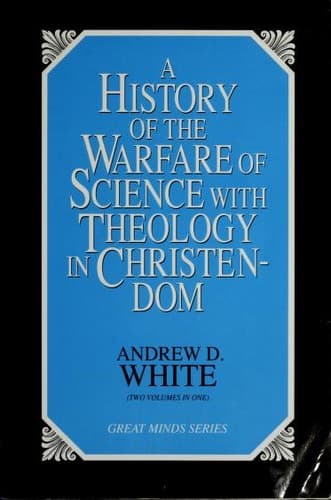
History of the Warfare of Science with Theology in ChristendomWhite, Andrew Dickson
Religion
History of the Warfare of Science with Theology in Christendom
White, Andrew Dickson
Religion and science -- History
(66) For Chiaramonti's book and selections given, see Gebler as above,
p. 271. For Polacco, see his work as cited, especially Assertiones i,
ii, vii, xi, xiii, lxxiii, clcccvii, and others. The work is in the
White Library at Cornell University. The date of it is 1644.
But any sketch of the warfare between theology and science in this field
would be incomplete without some reference to the treatment of Galileo
after his death. He had begged to be buried in his family tomb in Santa
Croce; this request was denied. His friends wished to erect a monument
over him; this, too, was refused. Pope Urban said to the ambassador
Niccolini that "it would be an evil example for the world if such
honours were rendered to a man who had been brought before the Roman
Inquisition for an opinion so false and erroneous; who had communicated
it to many others, and who had given so great a scandal to Christendom."
In accordance, therefore, with the wish of the Pope and the orders of
the Inquisition, Galileo was buried ignobly, apart from his family,
without fitting ceremony, without monument, without epitaph. Not until
forty years after did Pierrozzi dare write an inscription to be placed
above his bones; not until a hundred years after did Nelli dare transfer
his remains to a suitable position in Santa Croce, and erect a monument
above them. Even then the old conscientious hostility burst forth: the
Inquisition was besought to prevent such honours to "a man condemned for
notorious errors"; and that tribunal refused to allow any epitaph to be
placed above him which had not been submitted to its censorship. Nor has
that old conscientious consistency in hatred yet fully relented: hardly
a generation since has not seen some ecclesiastic, like Marini or De
Bonald or Rallaye or De Gabriac, suppressing evidence, or torturing
expressions, or inventing theories to blacken the memory of Galileo
and save the reputation of the Church. Nay, more: there are school
histories, widely used, which, in the supposed interest of the Church,
misrepresent in the grossest manner all these transactions in which
Galileo was concerned. Sancta simplicitas! The Church has no worse
enemies than those who devise and teach these perversions. They
are simply rooting out, in the long run, from the minds of the more
thoughtful scholars, respect for the great organization which such
writings are supposed to serve.(67)
(67) For the persecutions of Galileo's memory after his death, see
Gebler and Wohwill, but especially Th. Martin, p. 243 and chaps. ix
and x. For documentary proofs, see L'Epinois. For a collection of the
slanderous theories invented against Galileo, see Martin, final chapters
and appendix. Both these authors are devoted to the Church, but unlike
Monsignor Marini, are too upright to resort to the pious fraud of
suppressing documents or interpolating pretended facts.
Public-domain text, read in full here on John Shaqi.
Reviews
Reviews
No reviews yet
Be the first to share your thoughts on this work.
Elsewhere in the archive
Join the Discussion
Join the discussion
Sign in to leave a comment or review.
Sign InorCreate an account